 ultimate-guide
Best Sleeping Positions for Lower Back Pain
Table of Contents
- Why Sleeping Position Matters for Lower Back Pain
- Side Sleeping with Pillow Support
- Back Sleeping with Knee Elevation
- Why Stomach Sleeping Should Be Avoided
- Best Mattress for Back Pain Support
- Stretches for Lower Back Pain Relief Before Bed
- Getting Out of Bed with Lower Back Pain
- When to Seek Professional Care
- Frequently Asked Questions
Last Updated: September 29, 2026
Why Sleeping Position Matters for Lower Back Pain
Your sleeping position directly affects spinal alignment, muscle tension, and pain levels throughout the night. When your spine isn't properly supported, pressure accumulates on vertebrae and surrounding tissues, leading to morning stiffness, increased inflammation, and persistent discomfort. The best sleeping positions for lower back pain prioritize neutral spine alignment, where your vertebrae stack naturally without excessive curves or twists. (Source: National Institutes of Health (NIH) guidelines)
Eight hours of poor positioning can undo daytime stretching or physical therapy benefits. Patients who adjust sleep posture often see noticeable pain reduction within the first week. Proper alignment reduces sciatic nerve pressure, minimizes morning stiffness, and allows damaged discs to recover more effectively.
Your ideal position depends on your specific condition, herniated disc, general strain, or sciatica. Below, we'll show you how to position your body for maximum relief and which mattress and pillow combinations support healing.
Side Sleeping with Pillow Support
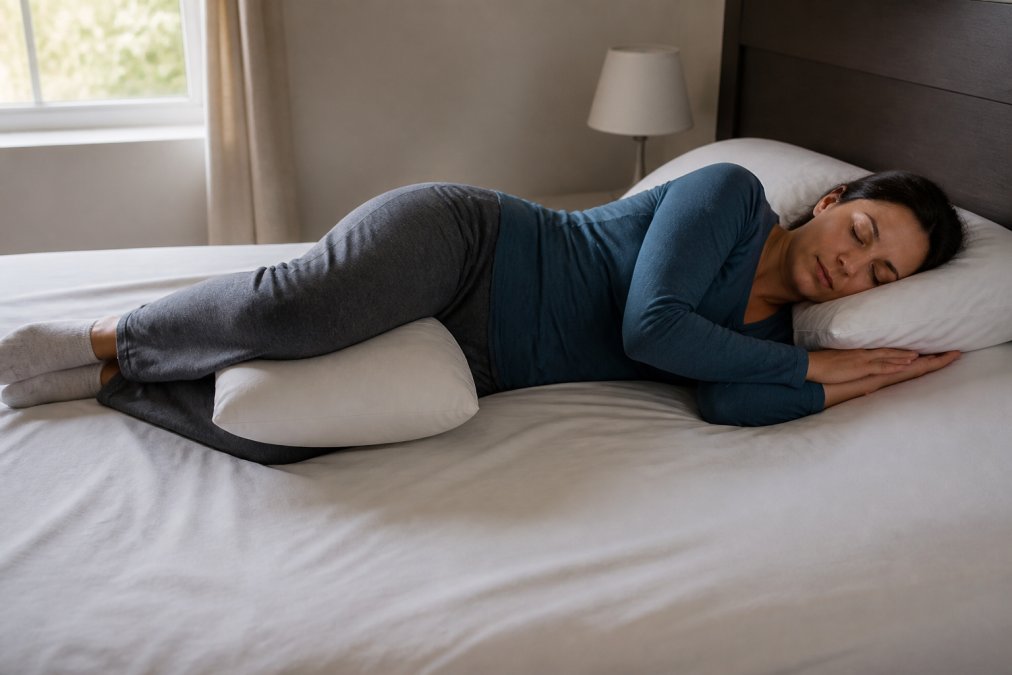
Side sleeping is often the best sleeping position for lower back pain because it naturally maintains a more neutral spine when done correctly. This position reduces pressure on the lumbar region and keeps your vertebral column in a straighter line compared to other postures.
How to position your knees and hips
Stack your hips directly over one another and place a pillow between your knees to keep them aligned. This prevents your top leg from dropping across your body and twisting your lower spine. Keep knees slightly bent to reduce hip and lower back strain.
Stack your shoulders as well, if your top shoulder rolls forward, you'll rotate your torso and compromise alignment. A body pillow helps maintain this stacking throughout the night.
Pillow placement for back pain relief
Pillow loft must match your shoulder width. Too low causes neck flexion and cervical stress; too high causes extension. Ideal height keeps your head neutral with ears aligned to shoulders.
Use a specialized knee pillow like the Coop Home Goods or Everlasting Comfort model rather than a standard pillow. These prevent shifting and maintain hip alignment. A thinner pillow works better, just enough to prevent pelvic tilt without forcing an unnatural position.
Back Sleeping with Knee Elevation
Back sleeping is the second-best option for lower back pain with proper pillow support. It distributes weight evenly, reducing pressure points and allowing deeper muscle relaxation.
Achieving neutral spine alignment
Place a pillow under your knees, bent at roughly 15-20 degrees. This reduces lumbar arch, prevents hyperextension, and dramatically reduces lumbar strain.
Keep your head pillow neutral, ears aligned with shoulders.
Why Stomach Sleeping Should Be Avoided
Stomach sleeping forces extreme cervical rotation and hyperextends your lower back, compressing discs and creating sustained twisting stress that radiates down your spine.
Best Mattress for Back Pain Support
Your mattress is equally important as your sleeping position. Too soft allows pelvic sinking and excessive lumbar curve; too firm creates pressure points that disrupt blood flow.
Firmness levels and spinal alignment
For lower back pain relief, aim for a firmness of 6.5 to 8 on a 1-10 scale. A 6.5-7.5 rating prevents sinking while maintaining pressure relief; 7.5-8 suits heavier individuals or severe disc issues.
Mattress construction and material properties
The internal construction of your mattress directly affects how well it supports your spine during the hours you spend in each sleeping position.
Mattress type and pillow loft correlation
Pillow loft should increase roughly half an inch for every mattress firmness increase. Firm latex pairs with 4-5 inch pillows; softer memory foam with 3-4 inch pillows. This maintains neutral spine alignment.
Mattress trial periods and return policies
Most manufacturers offer 90-120 night trials. Your body needs 2-4 weeks to adjust, so initial discomfort doesn't mean the mattress is wrong. If pain persists beyond 4 weeks, the firmness or material likely isn't suited to you. Track pain levels during the trial period.
Stretches for Lower Back Pain Relief Before Bed
A pre-sleep mobility routine reduces morning stiffness and allows deeper relaxation. These stretches activate parasympathetic responses. Match your routine to your specific pain pattern, general soreness, disc-related pain, or sciatica require different approaches.
Understanding your pain pattern before stretching
Identify whether your pain is muscular (improves with movement), disc-related (worsens with forward bending), or nerve-related (radiating down the leg), as some stretches can worsen certain conditions.
- Muscular lower back pain (tight erector spinae, quadratus lumborum, or gluteal muscles) responds well to gentle lengthening stretches that decompress the lumbar spine.
- Disc-related pain (including herniated discs) often worsens with forward bending, so stretches that extend the spine or avoid excessive flexion are safer.
- Sciatica or nerve compression requires caution with hamstring stretches, as aggressive stretching can irritate the sciatic nerve further.
Pre-sleep mobility routine for general muscle soreness
Perform these stretches 10-15 minutes before bed, holding each for 30 seconds without bouncing. This routine is safe for most people with general lower back strain:
-
Cat-cow stretch: On hands and knees, alternate between arching your back (cow) and rounding your spine (cat). Perform 8-10 slow cycles. This mobilizes your entire vertebral column and reduces tension in the thoracic and lumbar regions. The gentle flexion and extension help your discs rehydrate and your muscles release accumulated tension from the day.
-
Child's pose: Kneel and fold forward, resting your forehead on the ground or a pillow. Keep your arms extended in front of you or alongside your body. Hold for 30-60 seconds. This passively stretches your lower back, latissimus dorsi, and shoulder muscles while allowing gravity to gently decompress your lumbar discs. If your knees are sensitive, place a pillow between your glutes and heels.
-
Supine twist: Lying on your back with knees bent, pull one knee toward your chest, then gently rotate it across your body while keeping your opposite shoulder on the ground. Hold for 30 seconds on each side. This releases rotational tension in your lumbar spine and mobilizes your thoracic spine, which often compensates for lower back stiffness.
-
Knee-to-chest hold: Still on your back, pull both knees toward your chest and hold for 30-60 seconds. This decompresses your lower back and stretches your gluteal muscles, which often contribute to sciatic nerve irritation and lower back pain. Avoid this stretch if it causes sharp pain; instead, hold one knee at a time.
Modified routine for disc-related pain
If your pain worsens with forward bending or you have a known disc issue, replace the child's pose and supine twist with these alternatives:
-
Prone press-up (sphinx pose): Lie face-down and prop yourself up on your forearms, gently extending your thoracic spine. Hold for 15-30 seconds. This mild extension can help centralize disc pain and reduce radiating symptoms, though stop immediately if pain increases.
-
Supine figure-four stretch: Lying on your back, cross one ankle over the opposite knee and gently pull the bottom leg toward your chest. This stretches the piriformis muscle without flexing your lumbar spine, reducing sciatic nerve irritation without aggravating disc pain.
Muscle relaxation and nervous system activation
After stretching, spend 5 minutes in progressive muscle relaxation. Starting with your feet, consciously tense each muscle group for 5 seconds, then release. Work upward through your calves, thighs, glutes, lower back, abdomen, chest, shoulders, neck, and face. This technique teaches your nervous system the difference between tension and relaxation, making it easier to achieve deep sleep and allowing your muscles to fully recover during the night.
Timing and consistency
Perform this routine every night, ideally at the same time, to train your body's sleep-wake cycle. Consistency matters more than intensity, a gentle 10-minute routine performed nightly will produce better results than occasional intense stretching. If you skip stretching for several nights, you'll likely notice increased morning stiffness, confirming that the routine is actively preventing muscle tightness.
Getting Out of Bed with Lower Back Pain
How you exit bed is as important as how you sleep. Rolling directly onto your feet forces your spine to rotate and creates sudden pressure on your lumbar discs. Instead, use the log-roll technique: roll onto your side, use your arms to push your upper body upright while swinging your legs off the bed simultaneously.
When to Seek Professional Care
If your pain persists beyond two weeks despite position changes, mattress adjustments, and stretching routines, professional evaluation is necessary. Chronic lower back pain often involves underlying issues, disc herniation, muscle imbalances, or nerve compression, that require targeted treatment.
Frequently Asked Questions
What's the worst sleeping position for back pain?
Stomach sleeping is the worst position for lower back pain because it forces your spine into an unnatural twist and removes support from your lumbar region. This position strains the cervical spine and prevents neutral spinal alignment. Side sleeping and back sleeping with proper support are significantly better choices for managing back pain and protecting your vertebrae.
How can I decompress my lower back while sleeping?
Decompression happens through proper spinal alignment and pressure relief. Back sleeping with a pillow under your knees elevates your legs and reduces lumbar strain. Side sleeping with a pillow between your knees maintains hip alignment and reduces pressure on the sciatic nerve. An adjustable bed base that elevates your legs can also help decompress the lower back by reducing vertebral compression throughout the night.
Does a firm mattress help with lower back pain?
Firmness matters, but it's not the only factor. A medium-firm to firm mattress generally provides better spinal support than a soft one, as it prevents excessive sinking that misaligns your vertebrae. However, the best mattress for back pain depends on your sleeping position and body weight. Side sleepers may need slightly softer support than back sleepers to prevent hip pressure points. Pairing the right mattress firmness with proper pillow loft and support creates the ideal sleep environment for pain relief.
How do I fix my lower back pain quickly through sleep?
Fast relief comes from combining three elements: the right sleeping position, proper pillow and mattress support, and pre-sleep stretches. Start by switching to side sleeping with a knee pillow or back sleeping with knee elevation to reduce lumbar strain immediately. Perform gentle stretches before bed to relax tense muscles and improve sleep quality. If pain persists beyond a few weeks, consult a healthcare professional to rule out serious conditions like herniated discs or sciatic nerve compression.