 comparison
Chiropractic Care for Acute Disc Injury: Worth It?
Table of Contents
- Is Chiropractic Care Worth It for Acute Disc Injury? The Verdict
- Understanding Your Acute Disc Injury and Treatment Options
- How Chiropractors Treat Acute Disc Herniations Without Surgery
- Chiropractic Care Recovery Timeline for Disc Injury: What to Expect
- Safety First: Risks, Contraindications, and Red Flags
- Signs a Disc Injury Needs Surgery Over Conservative Care
- Making Your Decision: Choosing the Right Care Path
- Frequently Asked Questions
Last Updated: September 8, 2026
Is Chiropractic Care Worth It for Acute Disc Injury? The Verdict
An acute disc injury is a sudden, often debilitating condition where the soft center of a spinal disc pushes through its tough exterior, sometimes irritating nearby nerves. The short answer is yes for many people, provided the treatment is low-force, targeted, and guided by a thorough evaluation, but it is not the right choice for every situation or every patient.
At Natural Healing Arts Medical, we offer comprehensive chiropractic care and wellness solutions in Bradenton, FL, aiming to help patients achieve their wellness objectives through effective, compassionate treatment options. This guide breaks down what an acute disc injury involves, how modern chiropractic techniques address it, and the critical safety considerations that determine whether spinal manipulation is appropriate for your specific case.
Understanding Your Acute Disc Injury and Treatment Options
A disc injury is classified by the severity of the structural damage to the vertebral column. The treatment path you choose should match that severity, and a proper diagnosis is the first step toward any meaningful recovery.
What Is a Herniated, Bulging, or Ruptured Disc?
A herniated disc is a condition where the inner gel-like core of a spinal disc protrudes through a tear in the tougher outer ring, often pressing against nearby spinal nerves. A bulging disc, by contrast, involves the outer ring stretching outward without tearing, while a ruptured disc describes a complete tear that allows core material to escape. All three can cause localized back pain, but the more concerning symptoms, such as radiating leg pain or numbness, typically occur when the displaced material touches a nerve root. This nerve compression, sometimes called radiculopathy or a pinched nerve, is what produces sciatica and other referred pain patterns down the limbs.
How Chiropractors Treat Acute Disc Herniations Without Surgery
Chiropractic care for an acute disc herniation focuses on reducing pressure on the affected nerve rather than forcing the disc back into place. The most effective approaches use low-force techniques that avoid the high-velocity thrusts many patients fear.
Flexion-Distraction and Spinal Decompression Therapy
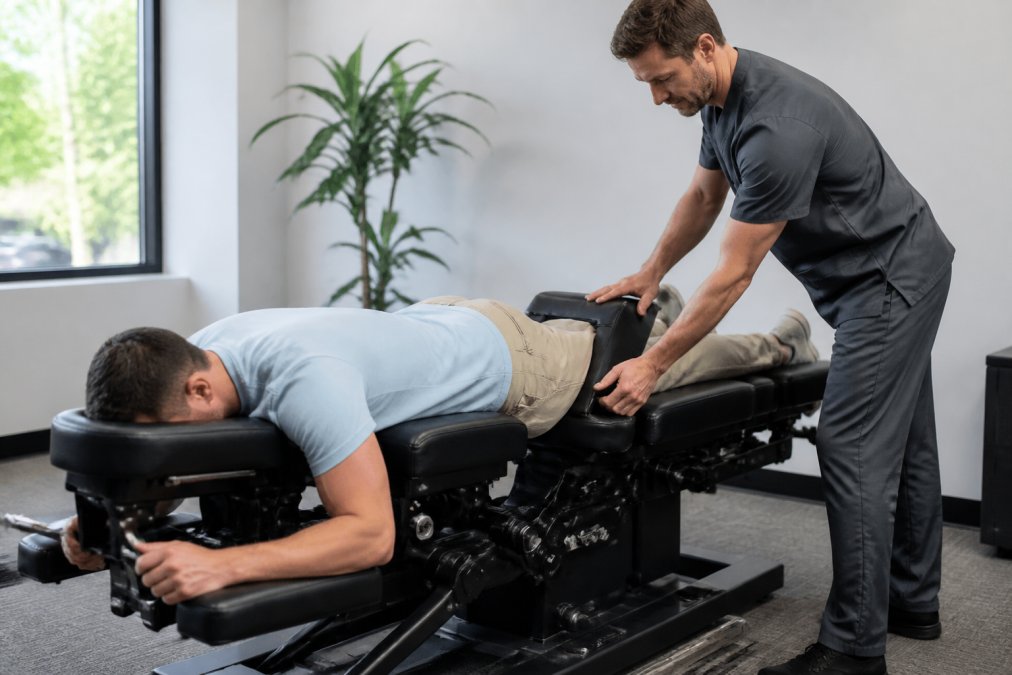
Flexion-distraction is a non-surgical, low-force spinal manipulation technique that uses a specialized table to gently stretch and flex the spine, reducing intradiscal pressure so the disc material can retract from the nerve (PubMed). Spinal decompression therapy uses computer-controlled traction cycles to create negative pressure within the disc itself, promoting healing and reducing radicular pain. The key difference: flexion-distraction is often preferred for acute herniations, while decompression therapy may suit patients who have not responded to standard physical therapy.
Chiropractic Care Recovery Timeline for Disc Injury: What to Expect
Recovery from an acute disc injury is a staged process that hinges on respecting the biology of the injury. The treatment goals, the type of chiropractic care, and your own activity level must change dramatically between the acute inflammatory phase (the first 72 hours to 2 weeks) and the rehabilitation phase (weeks 3 through 12+). Pushing into aggressive stretching or strengthening too early is a common cause of re-injury and prolonged pain.
The Acute Inflammatory Phase (Days 1-14): Protect and Settle
In the first 48 to 72 hours after the injury, the body's inflammatory response is peaking (peer-reviewed research). The disc and surrounding nerve root are swollen and highly sensitive. The primary goal is pain modulation and protection, not 'fixing' the disc. A skilled chiropractor will avoid any high-velocity thrust or deep-pressure technique over the symptomatic area. Instead, the focus is on:
- Gentle flexion-distraction: Using a specialized table to create a rhythmic, low-force pumping motion that helps open the intervertebral foramen and reduce intradiscal pressure, taking tension off the irritated nerve.
- Ice and activity modification: You will likely be advised to avoid bending, lifting, and twisting, and to use ice packs for 15-20 minutes several times a day to help control local inflammation.
- Ergonomic assessment: A quick review of your workstation and sleeping position to minimize stress on the lumbar spine during the most vulnerable period.
What to expect: You should not expect to be 'pain-free' in this phase. The realistic goal is a measurable reduction in the intensity of radiating leg pain (sciatica) and a calming of severe muscle spasms. If your radiating pain is worsening or spreading during this phase, that is a red flag that the current approach is not working and requires immediate re-evaluation.
The Transition Phase (Weeks 2-4): From Passive to Active
As the acute inflammation subsides, your chiropractor will begin to introduce specific, low-load stabilization exercises. The goal is to retrain the deep core stabilizers, the transversus abdominis and multifidus, which often 'switch off' after an injury. This phase typically includes:
- Continued flexion-distraction or gentle mobilization to maintain joint mobility.
- Introduction of isometric core exercises (e.g., abdominal bracing, bird-dog holds) that do not involve spinal flexion.
- Nerve gliding exercises (e.g., sciatic nerve flossing) to improve nerve mobility and reduce sensitivity, which is a key step often missed in generic recovery plans.
What to expect: By the end of week four, most patients can perform daily activities (walking, sitting for 30-45 minutes) with significantly less pain. The key milestone is centralization, leg pain retreating toward the lower back, which is a positive prognostic sign for full recovery.
The Rehabilitation Phase (Weeks 4-12+): Build Resilience
This is the phase where most generic guides stop, but it is where the real work happens to prevent recurrence. The disc injury may be healing, but the supporting musculature is deconditioned. The focus shifts to progressive loading and functional restoration:
- Dynamic strengthening: Progressing from isometric holds to controlled dynamic movements like squats, lunges, and deadlifts (with light weights or bodyweight) to build strength and endurance in the entire kinetic chain.
- Spinal mobility work: Gentle, controlled movements to restore full range of motion without provoking symptoms.
- Return-to-activity planning: A structured plan for returning to work, sports, or hobbies, addressing the specific physical demands of your life.
What to expect: Significant functional improvement is common by the 6-8 week mark, but full tissue remodeling of the disc annulus can take 3 to 6 months. The timeline is heavily dependent on patient compliance with the home exercise program and ergonomic changes.
Why This Distinction Matters for Your Decision
Understanding the difference between the acute and rehabilitation phases is critical for deciding if chiropractic care is 'worth it.' If a practitioner offers only passive treatments without a clear plan to transition you into active rehabilitation, you are likely to experience temporary relief without long-term structural improvement. Conversely, a practitioner who pushes aggressive exercise during the acute phase is not respecting the healing process. The worth of chiropractic care lies in the practitioner's ability to navigate you safely through these distinct phases with a clear, evolving plan.
Safety First: Risks, Contraindications, and Red Flags
Chiropractic spinal manipulation is generally safe for acute disc injuries when performed by a qualified practitioner using appropriate techniques, but it carries real risks. The most significant concern is the rare possibility of worsening nerve compression or causing a neurological deficit. A thorough history and physical examination are non-negotiable before any treatment begins.
When Spinal Manipulation Should Be Avoided
Spinal manipulation should be avoided entirely in patients with severe osteoporosis, spinal fractures, inflammatory arthritis affecting the spine, or signs of cauda equina syndrome (peer-reviewed research). These are absolute contraindications where high-velocity adjustments could cause serious harm. Additionally, if you experience red flag symptoms such as loss of bladder or bowel control, progressive weakness in both legs, or numbness in the saddle area, you need immediate emergency room care, not a chiropractic appointment. These symptoms indicate a surgical emergency that requires urgent evaluation, and delaying care can lead to permanent damage.
Signs a Disc Injury Needs Surgery Over Conservative Care
Most acute disc injuries respond well to conservative care, but certain signs indicate that surgical intervention may be the safer or more effective path. Progressive neurological deficit, weakness that continues to worsen despite treatment, is one of the strongest indicators that surgery should be considered. Similarly, failing an adequate trial of non-surgical treatment for six to twelve weeks with no measurable improvement warrants discussing surgical options like microdiscectomy.
The decision between conservative care and surgery is about matching the treatment to the specific pathology and your individual response. A large disc sequestration with significant nerve compression and progressive symptoms typically warrants surgical evaluation. By contrast, a small contained herniation with manageable pain and no neurological decline often resolves with time and appropriate conservative management.
Making Your Decision: Choosing the Right Care Path
The decision about whether chiropractic care is worth it for your acute disc injury is a clinical one. It hinges on a single question: Is your specific disc injury a candidate for manual therapy, or is it a structural problem that requires a different intervention? The only way to answer that question is through a thorough history, a focused neurological exam, and the integration of diagnostic imaging when indicated.
The Role of MRI and CT: Not Optional, but Selective
A competent chiropractor uses imaging to determine if and how to treat you. An MRI is the gold standard for visualizing soft tissue like the intervertebral disc and nerve roots. It reveals the type, size, and location of the herniation. This is where the decision tree branches.
- Contained Disc Bulge or Protrusion: The outer annulus is intact or only partially torn, and the disc material is still within the disc space. This is the most common presentation and is highly amenable to conservative care, including flexion-distraction and decompression.
- Extruded Disc: The disc material has broken through the annulus but is still connected to the disc. This is often the most painful type because the free fragment can migrate and directly irritate the nerve root. Many of these still respond well to conservative care, but the treatment must be more cautious.
- Sequestered Disc: A free fragment of disc material has broken off entirely and is floating in the spinal canal. This is a critical distinction. A sequestered disc is a relative contraindication for forceful spinal manipulation. The risk is that a high-velocity thrust could cause the free fragment to migrate further and worsen nerve compression. A chiropractor who sees a sequestered fragment on an MRI should either refer you for a surgical consultation or limit care to extremely gentle, non-thrust techniques while closely monitoring your neurological status.
A Practical Decision Pathway: What Your Imaging Should Tell You
When considering chiropractic care, ask your provider to walk you through your MRI findings in the context of your symptoms. A responsible practitioner will use the imaging to rule you in or out for care, not just to confirm a diagnosis. Here is a practical framework:
| Imaging Finding | Neurological Symptoms | Recommended Path |
|---|---|---|
| Contained bulge/protrusion | Mild radiating pain, no weakness | Chiropractic care (flexion-distraction) is a first-line option |
| Extruded disc | Moderate radiculopathy, some numbness | Chiropractic care is reasonable, but with low-force techniques and close monitoring |
| Sequestered fragment | Significant leg pain, any motor weakness | Surgical consultation is warranted before any manual therapy |
| Any disc pathology | Cauda equina signs (bladder/bowel dysfunction, saddle anesthesia) | Immediate ER, not a chiropractor |
The 'Two-Week Trial' Rule
If you and your chiropractor decide to proceed with conservative care, the decision should not be open-ended. A common and responsible approach is a two-week trial of care, a diagnostic test, not a commitment to a 12-week package. If you do not see a measurable reduction in your primary symptom (usually radiating leg pain) within 10-14 days of consistent, appropriate care, it signals that either the diagnosis is wrong, the treatment is ineffective, or the injury is more severe than initially thought. At that point, re-evaluation, possibly with updated imaging or a referral to a spine specialist, is the correct next step.
The Bottom Line for Your Decision
The worth of chiropractic care is a conditional yes, defined by your imaging and neurological status. A provider who offers a treatment plan without first explaining what your MRI does and does not show is not giving you the information needed to make an informed decision. The right care path is one where the practitioner is as willing to say 'this is not a chiropractic case' as they are to say 'I can help you.' Look for a provider who integrates imaging into their clinical reasoning, offers a clear trial period, and has a defined protocol for when to refer you out.
Frequently Asked Questions
Can a chiropractor help an L4-L5 bulging disc?
Yes, a chiropractor can often help with an L4-L5 bulging disc using low-force techniques like flexion-distraction. This method gently stretches the spine to reduce pressure on the disc and nearby nerves. Many patients find relief from sciatica and lower back pain without surgery. A thorough exam, including imaging if needed, helps determine if chiropractic care is appropriate for your specific disc injury.
Why do some medical doctors discourage chiropractic care for disc injuries?
Some medical doctors discourage chiropractic care because of concerns about high-velocity spinal manipulation on an already injured disc. However, many chiropractors use gentler methods like flexion-distraction and spinal decompression, which are designed for acute disc herniations. The key is choosing a practitioner experienced in disc injuries and ensuring you have a proper diagnosis to rule out contraindications before starting treatment.
What is the fastest way to heal a herniated disc in the lower back?
For most people, the fastest path involves conservative care during the acute phase. This typically includes relative rest for a day or two, followed by gentle movement and treatments like chiropractic adjustments or physical therapy to reduce inflammation and pressure on the nerve. Your chiropractor will guide you through a recovery timeline for your disc injury, which usually spans several weeks with gradual improvement.
What are the signs that a disc injury needs surgery instead of chiropractic care?
Surgery becomes a consideration when you have signs of a neurological deficit that worsens, such as significant leg or arm weakness, loss of bladder or bowel control, or numbness in the saddle area. These are red flags requiring immediate medical attention. If conservative care fails to improve symptoms after several weeks or if you have severe, progressive nerve damage, your doctor may discuss surgical intervention.