 how-to
Chiropractic Care for Chronic Sciatica: A Complete Guide
Table of Contents
- What Is Sciatica and Why Chiropractic Care Helps
- Common Chiropractic Techniques for Sciatica Treatment
- How Long Does Sciatica Take to Heal With a Chiropractor
- Chiropractor vs Physical Therapy for Sciatica
- Exercises for Sciatica Recommended by Chiropractors
- What to Expect During Your First Chiropractic Visit
- Safety, Risks, and Contraindications of Chiropractic Care
- Conclusion
- Frequently Asked Questions
Last Updated: August 3, 2026
What Is Sciatica and Why Chiropractic Care Helps
Sciatica affects millions of Americans annually, causing pain radiating from the lower back through the legs and feet. At Natural Healing Arts Medical in Bradenton, Florida, we address the root mechanical issues driving this condition rather than merely masking symptoms with medication.
The sciatic nerve is the longest single nerve in the human body, running from your lumbar spine through your buttocks and down each leg. When vertebral misalignments, herniated discs, or tight muscles compress this nerve, the result is sharp, burning, or tingling pain that can make sitting, standing, or walking unbearable.
How nerve compression develops
Nerve compression typically develops through poor posture, repetitive strain, muscle imbalances, or previous injuries. A minor car accident, fall, or years of desk work can shift vertebral alignment enough to irritate the sciatic nerve. The inflammation that follows creates a vicious cycle: compressed nerve triggers muscle tightness, which increases compression, which worsens inflammation. Chronic nerve impingement can lead to progressive neurological symptoms if left untreated, including weakness and loss of sensation.
Why chiropractic care targets the root cause
Chiropractic care works by restoring proper spinal alignment and reducing mechanical pressure on the nerve itself. Rather than prescribing pain medication that temporarily masks symptoms, chiropractors use spinal manipulation, therapeutic exercises, and postural correction to address why the nerve is being compressed.
When vertebral subluxation (misalignment) is corrected, the space around the nerve increases, inflammation decreases, and the body's natural healing response activates. Combined with targeted stretching and strengthening exercises, this approach creates conditions for actual recovery rather than dependency on pain management.
Common Chiropractic Techniques for Sciatica Treatment
Chiropractors employ several evidence-based techniques to relieve sciatic nerve pain and restore function. The specific combination depends on your individual condition, imaging findings, and response to initial treatment.
Spinal manipulation and adjustments
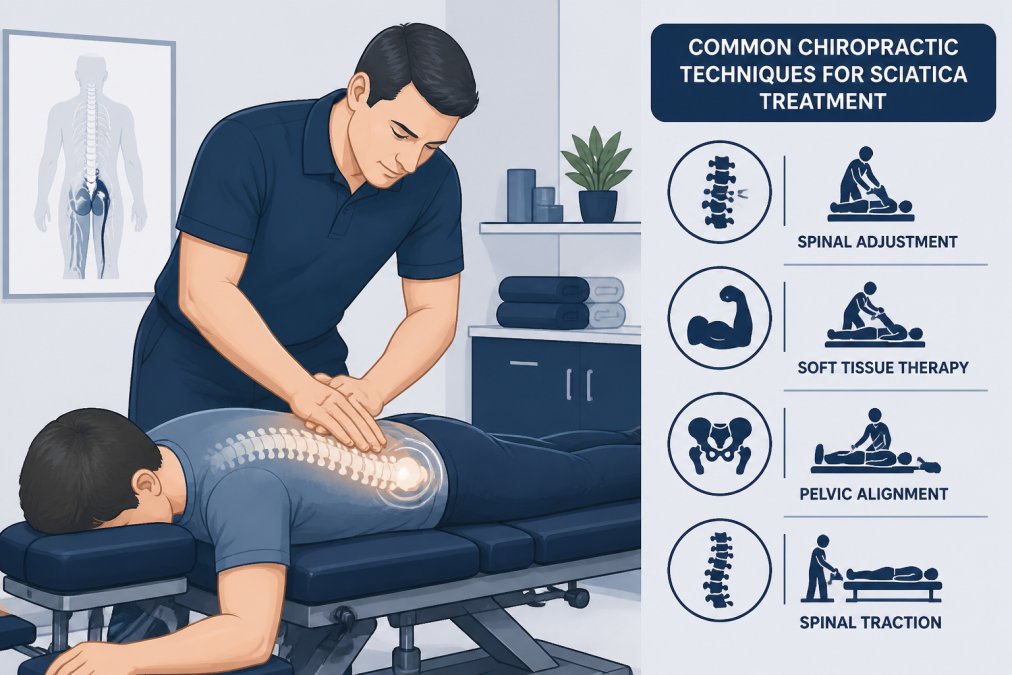
Spinal manipulation is the cornerstone of chiropractic treatment for sciatica. When a vertebra is misaligned, it restricts the space available for the nerve root. A skilled adjustment restores proper alignment, immediately reducing pressure on the sciatic nerve.
Many patients report immediate relief after a single adjustment, though lasting improvement typically requires a series of treatments.
Myofascial release and joint mobilization
Chiropractors use myofascial release techniques to address tight muscles that often accompany and worsen sciatic nerve compression. Deep tissue massage and trigger point therapy release tension patterns in the myofascial system, the connective tissue surrounding muscles.
Joint mobilization involves moving joints through their range of motion in specific directions to restore normal movement patterns. When muscles like the piriformis (which sits directly over the sciatic nerve in the buttocks) are tight, they can compress the nerve independently of spinal misalignment. Releasing this muscle often provides dramatic pain relief.
How Long Does Sciatica Take to Heal With a Chiropractor
Recovery timelines vary significantly based on how long you've suffered, the severity of nerve compression, and your commitment to at-home exercises.
Factors that affect recovery timeline
Acute sciatica (pain lasting less than six weeks) often responds quickly to chiropractic care, with many patients seeing noticeable improvement within 2-4 weeks of consistent treatment. Chronic sciatica, pain persisting for months or years, requires longer treatment because inflammation and muscle guarding patterns are deeply established.
Your age, overall health, and spinal degenerative changes also matter. Younger patients with minimal disc degeneration typically heal faster than older patients with arthritis or multiple herniated discs. How strictly you follow at-home exercise recommendations significantly impacts recovery speed. The severity of nerve compression revealed by imaging is another critical factor, a mild bulging disc responds faster than a large herniated disc or bone spur. Some patients need 8-12 weeks of regular treatment, while others require 3-6 months for complete resolution.
Long-term maintenance protocols
Once acute pain resolves, periodic adjustments combined with ongoing home exercises prevent vertebral misalignment from returning. A typical maintenance plan involves monthly or quarterly adjustments after the intensive treatment phase ends. The exercises you learn during treatment become lifelong tools, stretches for the hip flexors, piriformis, and hamstrings should be performed 3-4 times weekly indefinitely. Prevention through maintenance is far more cost-effective than waiting for pain to return.
Chiropractor vs Physical Therapy for Sciatica
Both chiropractic care and physical therapy address sciatica, but they approach treatment differently.
Key differences in approach
Physical therapy focuses primarily on strengthening weak muscles and improving movement patterns through exercise. Chiropractic care emphasizes correcting spinal alignment and reducing nerve compression through manipulation and adjustment. In reality, sciatica usually involves both problems: your spine may be misaligned (requiring adjustment) AND your core muscles may be weak (requiring strengthening exercises).
Physical therapists don't perform spinal manipulation, so they can't directly correct vertebral misalignment. Chiropractic care often shows faster initial pain relief because adjustment directly reduces nerve compression, though many chiropractors incorporate therapeutic exercise into their treatment.
When to combine both treatments
The most effective approach for chronic sciatica often combines chiropractic care and physical therapy. Your chiropractor corrects spinal alignment and reduces acute nerve compression while your physical therapist builds the muscular support system that keeps your spine stable long-term. Insurance coverage sometimes supports this combined approach, with many plans covering both chiropractic and physical therapy for sciatica. The timeline for combined treatment is typically 8-12 weeks, with chiropractic adjustments 2-3 times weekly during the first month, then tapering to weekly as your physical therapist increases exercise intensity.
Exercises for Sciatica Recommended by Chiropractors
Chiropractic adjustments provide immediate relief, but exercises create lasting improvement by addressing the muscle imbalances and weakness underlying your sciatica. These therapeutic exercises should be performed consistently, ideally daily during acute phases, then 3-4 times weekly for maintenance.
Stretches to reduce nerve compression

The piriformis stretch is essential because this deep buttock muscle sits directly over the sciatic nerve. Lie on your back, pull one knee toward your opposite shoulder, and hold for 30 seconds. Repeat 3 times per leg, twice daily.
Hamstring stretches address the back of your thigh, where tightness contributes to sciatic nerve irritation. Standing or seated hamstring stretches should be held for 30-45 seconds and repeated 3 times per leg. Never bounce; static stretching is far more effective than ballistic stretching for nerve-related pain.
The figure-four stretch combines hip and piriformis stretching. Lie on your back, cross one ankle over the opposite knee, and pull the bottom leg toward your chest. Lower back stretches, particularly child's pose and knee-to-chest stretches, reduce tension in the lumbar spine and decompress the discs that may be compressing your sciatic nerve. Hold child's pose for 60 seconds, repeat 2-3 times.
Hip flexor stretches address the front of your hip, where tightness from prolonged sitting creates postural imbalance that increases lumbar spine stress. A low lunge position stretches the hip flexor of the back leg while gently extending your lumbar spine. Hold for 45 seconds per side.
Strengthening exercises for long-term relief
Strengthening your core, the deep abdominal and back muscles that stabilize your spine, is critical for preventing sciatica recurrence. Planks are the gold standard: hold a forearm plank for 30-60 seconds, rest, and repeat 3 times.
Bird dogs strengthen your lower back stabilizers while improving coordination. On hands and knees, extend one arm forward and the opposite leg backward, hold for 2-3 seconds, then alternate sides. Perform 10-12 repetitions per side, twice daily.
Glute strengthening prevents the hip weakness that often accompanies chronic sciatica. Clamshells and glute bridges activate the gluteus medius, which stabilizes your pelvis and reduces lumbar spine stress.
Quadriceps strengthening balances the hamstring tightness common in sciatica sufferers. Wall sits strengthen quads while improving endurance. Hold for 30-45 seconds, rest, repeat 3 times.
| Exercise | Duration | Frequency | Primary Benefit |
|---|---|---|---|
| Piriformis Stretch | 30 seconds | 2x daily | Direct sciatic nerve relief |
| Planks | 30-60 seconds | 3 sets daily | Core stabilization |
| Glute Bridges | 10-12 reps | 2x daily | Hip strength and pelvic stability |
| Hamstring Stretches | 30-45 seconds | 2x daily | Reduce posterior chain tension |
| Bird Dogs | 10-12 reps per side | 2x daily | Lower back stabilization |
| Child's Pose | 60 seconds | 2-3x daily | Lumbar decompression |
What to Expect During Your First Chiropractic Visit
Understanding what happens during your initial appointment reduces anxiety and helps you prepare for treatment. Your first visit is significantly longer than subsequent appointments because it includes comprehensive assessment and treatment planning.
Clinical assessment and diagnostic imaging
Your chiropractor will begin with a detailed history, asking about your pain onset, what movements worsen or improve symptoms, previous injuries, work environment, and daily habits. Next comes a physical examination including range of motion testing, orthopedic tests specific to sciatica (like the straight leg raise test), and palpation of your spine to identify misaligned vertebrae.
Many chiropractors order X-rays or MRI imaging to visualize your spine and confirm the location and severity of nerve compression. Imaging reveals herniated discs, bone spurs, stenosis, or other structural changes that explain your symptoms and guide treatment decisions.
Creating your personalized treatment plan
Based on your history, physical examination, and imaging findings, your chiropractor will explain your diagnosis in clear language: what's causing your sciatica, why it developed, and how treatment will address it. Your treatment plan will specify the frequency and duration of visits, the specific techniques that will be used, and the home exercises you'll perform. A typical plan for chronic sciatica might involve 2-3 visits weekly for 4 weeks, then tapering to weekly visits as you improve.
Natural Healing Arts Medical creates individualized plans rather than applying a generic protocol to every patient. Your specific misalignment pattern, disc condition, muscle weakness, and pain severity all influence your unique treatment approach.
Safety, Risks, and Contraindications of Chiropractic Care
Chiropractic care is generally safe when performed by a licensed, trained professional, but like any medical treatment, it carries potential risks that deserve honest discussion.
Spinal manipulation carries a small risk of temporary soreness or stiffness, similar to muscle soreness after exercise. This typically resolves within 24-48 hours. More serious but rare complications include nerve or blood vessel injury, though the incidence is extremely low when chiropractors follow proper technique and screening protocols.
Certain conditions contraindicate spinal manipulation entirely. Severe osteoporosis, active infection, cancer involving the spine, or significant ligamentous instability may make manipulation unsafe. Patients taking blood thinners should inform their chiropractor before treatment, as manipulation slightly increases bruising risk. Pregnancy doesn't contraindicate chiropractic care, but your chiropractor should use modified techniques and specialized equipment designed for pregnant patients.
Research demonstrates that spinal manipulation combined with exercise produces better outcomes for sciatica than either approach alone. What matters most is finding a chiropractor who listens to your concerns, explains findings clearly, and adjusts treatment if you're not improving as expected.
Natural Healing Arts Medical has maintained its selection as one of America's Best Chiropractors by the National Consumer Research Board for eleven consecutive years, a distinction earned through consistent patient outcomes and ethical practice standards.
Conclusion
Chronic sciatica doesn't have to define your life. The pain, numbness, and mobility loss you're experiencing respond to proper treatment when you address the mechanical root cause rather than merely masking symptoms.
Chiropractic care for chronic sciatica works because it restores spinal alignment, reduces nerve compression, and creates conditions for your body's natural healing. Combined with therapeutic exercises and postural correction, this approach produces lasting relief that medication alone cannot achieve.
Natural Healing Arts Medical in Bradenton specializes in exactly this type of comprehensive sciatica treatment. Dr. David Zamikoff and his team apply targeted spinal manipulation, myofascial release, and personalized exercise protocols to restore function and eliminate pain. They accept most health insurance and Medicare, offer flexible payment plans, and focus on faster recovery through evidence-based care.
If you've tried physical therapy alone, pain medication, or other treatments without lasting improvement, it's time to address the structural problem directly. Schedule your appointment with Natural Healing Arts Medical today and take the first step toward restored mobility and freedom from chronic sciatica pain.
Frequently Asked Questions
Can chiropractic care actually help chronic sciatica, or will I just end up back where I started?
Chiropractic care addresses the underlying causes of sciatica, such as nerve compression, herniated discs, and spinal misalignment, through spinal manipulation and myofascial release. Many patients experience pain relief and improved range of motion when combined with therapeutic exercises and long-term maintenance. Results vary based on the severity of your condition and how consistently you follow your treatment plan. A consultation with a qualified chiropractor can determine whether this approach is suitable for your specific situation.
How long does sciatica take to heal with a chiropractor, and how many visits will I need?
Recovery timelines vary significantly. Acute sciatica may improve in weeks, while chronic sciatica often requires several months of consistent treatment. Most patients begin with 2-3 visits per week initially, tapering as symptoms improve. Factors affecting healing include the severity of nerve compression, your age, overall health, and adherence to at-home exercises. Long-term maintenance protocols typically involve periodic adjustments after acute symptoms resolve to prevent recurrence. Your chiropractor will create a personalized plan based on your clinical assessment.
What makes chiropractic care different from just doing physical therapy on my own?
Chiropractic care combines spinal manipulation and joint mobilization with patient education and therapeutic exercises, addressing both the structural cause and symptom management. Physical therapy focuses primarily on strengthening and stretching. Many patients benefit from combining both approaches: chiropractic adjustments to reduce nerve impingement, plus physical therapy exercises for long-term functional improvement. The key difference is that chiropractors assess spinal alignment and use hands-on adjustments to correct vertebral subluxation, which can be difficult to address through exercise alone.
Are there any risks or contraindications I should know about before starting chiropractic treatment for sciatica?
Chiropractic adjustments are generally safe when performed by a qualified professional, but certain conditions require caution or alternative approaches. Severe osteoporosis, advanced spinal stenosis, or unstable fractures may contraindicate spinal manipulation. This is why a thorough clinical assessment and diagnostic imaging (such as X-rays or MRI) are essential before treatment begins. Your chiropractor will review your medical history and imaging results to ensure adjustments are appropriate for your condition and avoid making your disc injury or nerve compression worse.