 how-to
Chiropractic Treatment for Whiplash: A How-To Guide
Table of Contents
- What Is Whiplash and How Chiropractic Care Treats It
- Signs You Need a Chiropractor After a Car Accident
- The Step-by-Step Chiropractic Treatment Process for Whiplash
- How Many Chiropractic Visits for Whiplash Recovery
- Managing Whiplash Symptoms at Home Between Visits
- Insurance and Documentation for Whiplash Treatment
- Frequently Asked Questions
Last Updated: August 11, 2026
What Is Whiplash and How Chiropractic Care Treats It
Whiplash is a neck injury caused by rapid, forceful back-and-forth movement of the head, typically after a car accident. The cervical spine experiences sudden acceleration and deceleration that stretches ligaments, strains muscles, and damages soft tissues. At Natural Healing Arts Medical in Bradenton, we've treated hundreds of whiplash patients whose symptoms developed days or weeks after injury.
Whiplash-associated disorders trigger headaches, migraines, radiating arm pain, and neurological symptoms like numbness or tingling. Some patients experience severe range of motion loss, making head turning painful and difficult. Chiropractic treatment addresses the root cause rather than just masking pain through medication.
Chiropractic care combines spinal manipulation, myofascial release, therapeutic exercises, and ergonomic assessment to restore spinal alignment, reduce inflammation, and rehabilitate damaged soft tissue. The goal is sustainable recovery that prevents acute injuries from becoming chronic conditions.
Signs You Need a Chiropractor After a Car Accident
Not every car accident requires immediate chiropractic care, but certain signs indicate you should schedule an evaluation within 24-48 hours. Whiplash symptoms often develop gradually, you might feel fine at the accident scene, then wake up unable to move your neck.
Neck stiffness and pain that worsens with movement is the most obvious sign. Your range of motion becomes restricted, especially when turning your head side to side or tilting backward. Many patients describe a sensation of tightness like a band wrapped around their neck.
Headaches after a car accident deserve serious attention. Whiplash-related headaches often start at the base of the skull and radiate forward, sometimes triggering migraines. These indicate that your cervical spine alignment is off, affecting nerve function and blood flow.
Radiating pain or tingling in your arms and hands signals nerve involvement. Vertebral subluxation (misalignment) can compress nerves branching from your cervical spine, causing numbness in your fingers, grip weakness, or sharp pain down your arm.
Other warning signs include dizziness, difficulty concentrating, memory problems, and visual disturbances. Some patients experience sleep disruption because pain intensifies when lying down or muscle tension prevents comfortable positioning.
Any combination of these signs appearing after impact warrants professional evaluation. Prompt care also simplifies insurance documentation and shortens your recovery timeline.
The Step-by-Step Chiropractic Treatment Process for Whiplash
Chiropractic treatment for whiplash follows a structured protocol designed to address both the immediate injury and prevent long-term complications.
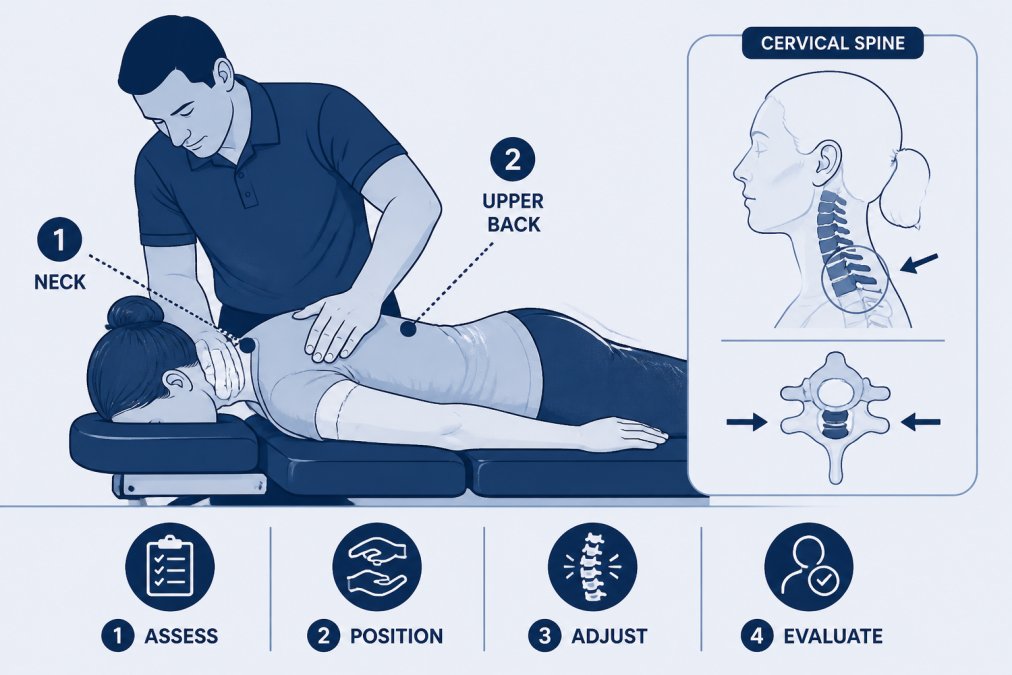
Step 1: Clinical Assessment and Diagnostic Imaging
Your first appointment begins with a detailed clinical assessment. The chiropractor will ask about the accident, speed, direction of impact, your vehicle position, and when symptoms started. This information reveals the likely mechanism of injury and predicts which tissues were damaged.
The physical examination includes range of motion testing, palpation of your cervical spine to identify misalignments, and neurological screening. The chiropractor assesses pain levels, muscle strength, and reflex responses to determine whether diagnostic imaging is necessary.
Diagnostic imaging is often essential for whiplash cases. X-rays reveal vertebral alignment and fractures or severe subluxations. MRI imaging provides detailed views of soft tissue damage, ligament strain, disc injuries, and muscle inflammation that X-rays cannot detect. At Natural Healing Arts Medical, we recommend imaging when clinical findings suggest structural damage requiring targeted intervention.
Step 2: Spinal Adjustments and Manipulation
Spinal manipulation is the cornerstone of chiropractic treatment for whiplash. The goal is to restore proper vertebral alignment and reduce biomechanical stress on your cervical spine. Misaligned vertebrae compress nerves, restrict blood flow, and perpetuate muscle guarding.
The chiropractor uses controlled force to move vertebrae back into proper position. Modern chiropractic adjustments are precise and often gentle. For acute inflammation, the chiropractor may use gentler techniques initially, gradually increasing intensity as inflammation decreases.
You'll typically receive adjustments 2-3 times per week initially, depending on injury severity and your body's response. Some patients feel immediate relief; others experience soreness for 24-48 hours as muscles adapt to proper alignment. This post-adjustment soreness is normal.
Step 3: Soft Tissue Therapy and Myofascial Release
While spinal manipulation addresses alignment, soft tissue therapy addresses muscle damage. Your neck muscles were stretched violently during impact, causing microscopic tears and inflammation. Without proper soft tissue treatment, these muscles remain tight and painful.
Myofascial release uses sustained pressure on tight muscle groups to release tension and restore normal tissue function. The chiropractor identifies trigger points and applies pressure to deactivate them, breaking the pain-muscle tension cycle that prevents healing.
Soft tissue mobilization may include instrument-assisted soft tissue therapy, which uses specialized tools to break up scar tissue and adhesions. These techniques improve circulation, reduce inflammation, and restore tissue function. Most patients notice improved range of motion within the first few sessions.
Step 4: Therapeutic Exercises and Rehabilitation
Therapeutic exercises rebuild strength and proprioception, your body's awareness of its position in space. Whiplash damages proprioceptors in your neck muscles, which is why many patients feel unstable during recovery.
Exercises start with gentle range of motion work, slow controlled movements in all directions to restore flexibility without triggering pain. As your neck strengthens, exercises progress to resistance work using bands or your own body weight. Neck stabilization exercises train your deep cervical muscles to support your spine and prevent re-injury.
Your chiropractor will teach you specific exercises to perform at home. Compliance matters significantly; patients who do their home exercises recover faster and experience fewer relapses. Most programs require 10-15 minutes of daily exercise for 4-8 weeks.
How Many Chiropractic Visits for Whiplash Recovery
The number of chiropractic visits needed varies based on injury severity, age, overall health, and how quickly your body responds to treatment.
Mild whiplash, with neck pain and stiffness but no radiating symptoms, typically requires 8-12 visits over 3-4 weeks. You'll likely notice significant improvement within the first week, with most symptoms resolving by week 4.
Moderate whiplash, involving radiating pain, headaches, or mild neurological symptoms, usually requires 15-25 visits over 6-8 weeks. Recovery is slower because your chiropractor must address both structural alignment and nerve involvement.
Severe whiplash, with significant neurological symptoms, substantial range of motion loss, or imaging findings of disc damage, may require 20-30+ visits over 8-12 weeks or longer. Your chiropractor will adjust treatment intensity based on your response.
Frequency typically follows this pattern: 2-3 visits per week for the first 2-4 weeks, then gradually reducing to 1-2 visits per week as inflammation decreases. By week 6-8, many patients transition to maintenance visits every 2-3 weeks. Your chiropractor will reassess your condition every 2-3 weeks to determine if your current visit frequency is appropriate.
Managing Whiplash Symptoms at Home Between Visits
Home care is crucial for whiplash recovery. What you do between chiropractic visits significantly impacts your healing timeline and outcome.

Ice application during the first 48-72 hours reduces inflammation and pain. Apply ice for 15-20 minutes every 2-3 hours, using a cloth barrier between ice and skin. After the initial inflammation phase, heat becomes more beneficial through warm showers, heating pads, or warm compresses.
Proper posture is essential during recovery. Keep your head directly over your shoulders, avoid slouching, and be careful with phone use. If you work at a desk, ensure your monitor is at eye level and your chair supports your neck properly.
Gentle stretching exercises prescribed by your chiropractor should be performed daily. These are controlled movements that maintain flexibility without triggering pain. Perform stretches slowly and hold each position for 15-30 seconds.
Avoid activities that aggravate your symptoms, including heavy lifting, sudden movements, and activities requiring rapid head turning. Many whiplash patients unknowingly re-injure themselves by returning to normal activities too quickly.
Sleep on your back or side, never on your stomach, which forces your head into unnatural rotation. Use a pillow that supports your neck's natural curve. A cervical pillow designed for whiplash recovery is often worth the investment.
Over-the-counter pain medication can be used cautiously, but avoid relying on it. Pain signals that you need to modify activity or seek additional treatment. If pain is severe, discuss medication options with your chiropractor or primary care physician.
Stress management supports recovery. Practice relaxation techniques like deep breathing, meditation, or gentle yoga. Adequate sleep is essential for healing.
Insurance and Documentation for Whiplash Treatment
Proper documentation makes insurance navigation significantly smoother. Insurance companies require specific information to approve and pay for chiropractic treatment.
Document the accident thoroughly. Take photos of vehicle damage, the accident scene, and any visible injuries. Get the other driver's information, insurance details, and witness contact information. This documentation proves your whiplash injury resulted from the accident.
Seek chiropractic care within 48 hours of the accident. Insurance companies are more likely to approve treatment when you seek care promptly, demonstrating that your injury is legitimate and serious.
Your chiropractor will document the accident mechanism, your symptoms, physical examination findings, imaging results, and treatment provided. This documentation is essential for insurance approval. At Natural Healing Arts Medical, we accept most health insurance and Medicare, and our team handles insurance documentation as part of your care.
Understand your insurance coverage before starting treatment. Call your insurance company and ask about chiropractic coverage for auto accident injuries, including your deductible, co-pay amounts, visit limits, and prior authorization requirements.
Keep detailed records of all treatment and expenses. Save receipts, billing statements, and records of out-of-pocket costs. Document any time missed from work due to your injury.
Communicate with your insurance company regularly. Provide updates on treatment progress and any changes in your condition. If your initial claim is denied, ask for the specific reason and request clarification on what documentation is needed for approval.
If another driver's negligence caused your injury, their liability insurance may cover your treatment. Your chiropractor can help you understand how to bill the at-fault party's insurance.
Whiplash injuries demand prompt, comprehensive treatment. The combination of spinal adjustments, soft tissue therapy, therapeutic exercises, and home care creates the most effective recovery pathway. Natural Healing Arts Medical specializes in treating whiplash and auto accident injuries with precision and compassion. Dr. David Zamikoff and our team have successfully guided thousands of patients through whiplash recovery, helping them restore mobility, eliminate pain, and return to normal life. Schedule your appointment today and take the first step toward sustainable healing.
Frequently Asked Questions
Can a chiropractor do anything for whiplash?
Yes. Chiropractors treat whiplash by addressing cervical spine misalignment, muscle spasms, and soft tissue damage caused by the injury. Through spinal manipulation, soft tissue therapy, and therapeutic exercises, chiropractic care reduces inflammation, restores range of motion, and alleviates pain. Many whiplash patients experience significant improvement in symptoms within weeks of starting treatment, though recovery depends on injury severity and consistency with the treatment plan.
How many chiropractic visits for whiplash typically needed?
Recovery timelines vary based on injury severity and individual healing. Mild whiplash may improve with 6-12 visits over 4-6 weeks, while moderate to severe cases often require 2-3 months of consistent treatment. Your chiropractor will perform a clinical assessment and diagnostic imaging to create a personalized plan. Most patients notice symptom reduction within the first 2-3 weeks of care, with full recovery continuing as inflammation decreases and neck strength returns.
What should you not do with whiplash?
Avoid sudden movements, heavy lifting, and high-impact activities during acute recovery. Do not ignore persistent pain or delay seeking treatment, early intervention prevents chronic pain development. Avoid prolonged immobility; gentle movement and prescribed exercises are essential. Don't self-treat with only ice or heat without professional guidance. Skip aggressive stretching or forcing range of motion beyond comfort. Avoid poor ergonomics at work or home, as this delays healing and can worsen symptoms like headaches and neck stiffness.
Is chiropractic care safe for acute whiplash injuries?
When performed by a qualified chiropractor, treatment is safe for acute whiplash. Chiropractors use diagnostic imaging and clinical assessment to rule out serious injuries before beginning manipulation. Spinal adjustments are tailored to your injury's severity, acute cases receive gentler techniques than chronic cases. Always disclose your accident details and any neurological symptoms to your chiropractor before treatment begins. If you experience severe pain, numbness, or radiating symptoms, seek immediate medical evaluation before chiropractic care.