 how-to
How Long Does Knee Replacement Recovery Take
Last Updated: November 9, 2026
Quick Summary
Knee replacement recovery is a gradual process that typically takes six months to a year or longer for full recovery, though many people resume everyday activities within weeks or months. Recovery has three phases: early healing in the first six weeks, functional recovery when you return to driving and stairs, and long-term full recovery when strength and range of motion plateau.
- Weeks 1-2 involve wound care, swelling control, and short walks with a walker.
- Many people move from a walker to a cane during weeks 3-6 as physical therapy intensifies.
- Walking without a walker or cane often happens within several weeks, but a normal gait can take several months.
- Skipping physical therapy sessions can slow range of motion and strength gains.
- Call your surgeon right away for fever, increasing redness, or calf pain and shortness of breath.
Table of Contents
- What Full Recovery From Knee Replacement Really Means
- Total Knee Replacement Recovery Week by Week
- 7 Days After Knee Replacement: What to Expect
- How Long Does It Take to Walk Normally After Knee Replacement?
- Range of Motion, Strength, and Physical Therapy Milestones
- Top 5 Mistakes After Knee Replacement
- When to Call Your Surgeon: Warning Signs and Urgent Care
- Exploring Surgery-Free Knee Osteoarthritis Care
- Frequently Asked Questions
What Full Recovery From Knee Replacement Really Means
Knee replacement recovery is a gradual process, and "full recovery" means something different at every stage. Full recovery is often described as the point when you can handle daily activities without thinking about your knee, though mild stiffness can linger for a year or more. At Natural Healing Arts Medical, we explain to patients that recovery has three distinct phases: early healing, functional recovery, and long-term full recovery. Understanding this distinction matters, because it stops people from comparing week two to month twelve.
The first phase covers wound healing and basic mobility, usually the first six weeks. The second phase is functional recovery, when you return to driving, stairs, and most daily tasks. Full recovery is the final stage, when strength and range of motion plateau and swelling stops. Many people resume everyday activities within weeks or months, while full recovery may take six months to a year or longer. A common mistake is expecting a single date when everything feels normal again. There isn't one.
Total Knee Replacement Recovery Week by Week
Week by week, total knee replacement recovery follows a fairly predictable pattern, though your pace will vary. The timeline below reflects general patterns described for an uncomplicated total knee replacement. Use it as a map, not a schedule.
- Weeks 1-2: Wound care, swelling control, and short walks with a walker. Pain medication is still part of the routine. Most people need help with meals, bathing, and household tasks during this window.
- Weeks 3-6: Physical therapy intensifies. You work on knee bending, knee extension, and strength. Many people move from a walker to a cane. Stairs become manageable with a rail.
- Weeks 6-12: Walking gets easier and endurance improves. Light daily activities return. Driving is often possible once you can brake safely and your surgeon clears you.
- Months 3-6: Strength builds steadily. Most people return to work and driving, and swelling becomes less frequent.
- Months 6-12: Range of motion and stamina improve. Vigorous activities may come back into reach, though mild stiffness can linger past the one-year mark.
What the calendar does not show is that recovery has three distinct phases, and mixing them up is a common source of frustration. Early recovery is the first six weeks, when the focus is wound healing and basic mobility. Functional recovery is when you return to driving, stairs, and most daily tasks. Full recovery is when strength and range of motion plateau and swelling stops, often six months to a year or longer.
Several factors move you along this timeline faster or slower. Age, baseline mobility before surgery, overall health, home support, and adherence to rehabilitation all matter.
A practical way to use this timeline is to track measurable milestones rather than dates. Ask your care team questions like: Can I walk a set distance without the walker? Can I straighten the knee fully? Can I bend it enough to sit and stand from a standard chair? Can I climb a flight of stairs with a rail?
Watch out: comparing your week four to someone else's week four ignores procedure type, baseline health, and complications, and it often pushes people to do too much too soon.
Here is the general week-by-week pattern for an uncomplicated total knee replacement.
| Timeframe | What typically happens |
|---|---|
| Weeks 1-2 | Wound care, swelling control, short walks with a walker |
| Weeks 3-6 | Physical therapy intensifies; many move from walker to cane |
| Weeks 6-12 | Walking gets easier; driving often possible once cleared |
| Months 3-6 | Strength builds; most return to work and driving |
| Months 6-12 | Range of motion and stamina improve; mild stiffness may linger |
7 Days After Knee Replacement: What to Expect
Seven days after knee replacement, most people are still in the earliest phase of healing. Swelling and bruising around the incision are normal. Pain is usually managed with prescribed medication, and walking happens with an assistive device such as a walker. You may feel frustrated by how little you can do, and that frustration is common.
Here is what the first week typically involves:
- Short walks several times a day, not long stretches
- Ice and elevation to control swelling
- Gentle exercises to keep the knee moving
- Wound care as directed by your surgeon
- Follow-up appointments to check the incision
Sleep is often the hardest part. Soreness at night can make rest difficult, and many people wake repeatedly. Our team has written a separate guide on managing knee pain while sleeping at night if that becomes your biggest obstacle in week one.
How Long Does It Take to Walk Normally After Knee Replacement?
How long does it take to walk normally after knee replacement? Many people walk without a walker or cane within several weeks, but a fully normal gait can take several months. The word "normal" is doing a lot of work here. Early walking is cautious and uneven. A smooth, confident stride comes later, once strength, balance, and range of motion return.
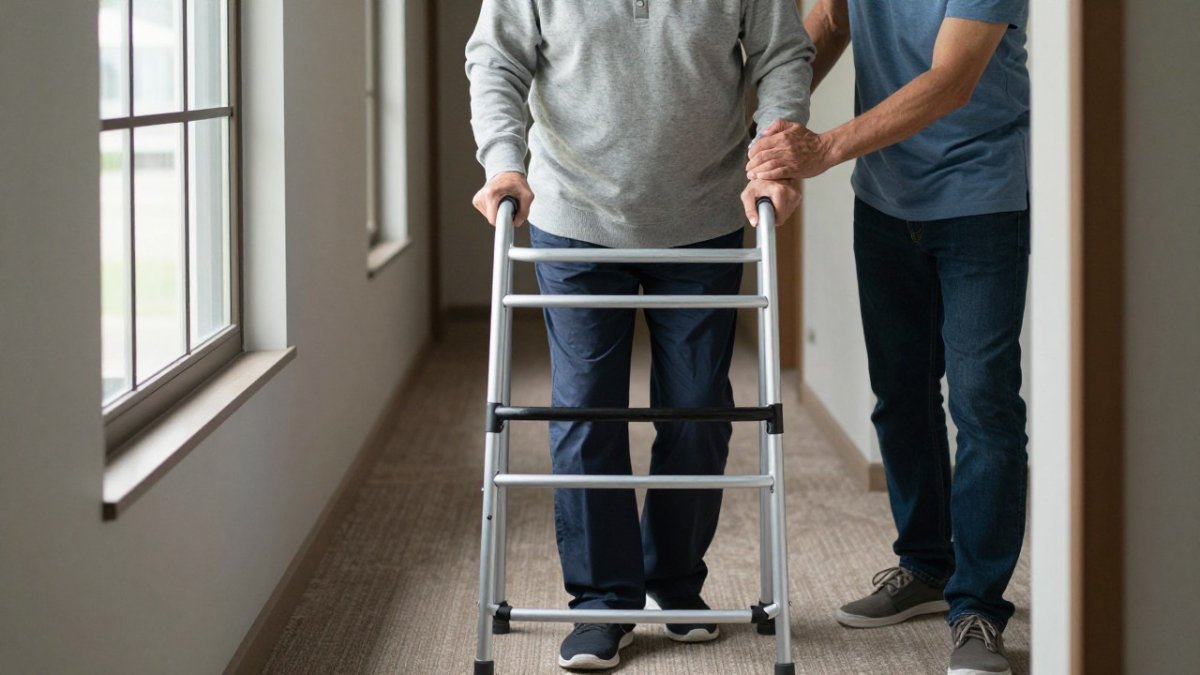
The progression usually follows a predictable sequence, and each stage has a measurable milestone you can discuss with your care team:
- Walker stage (typically weeks 1-4): You can stand and take short walks with the walker several times a day. The milestone is walking a set distance, for example, from one room to another, without increased swelling afterward.
- Cane stage (typically weeks 4-8): You can bear weight comfortably and walk short distances with a cane. The milestone is walking a hallway or around the block with the cane and no limp that worsens with fatigue.
- No-device stage (typically weeks 6-12): You can walk indoors and on level ground without support. The milestone is walking a quarter mile or the equivalent without stopping and without a limp.
- Normal gait (typically months 3-6): Your stride is even, your knee straightens fully at heel strike, and you can walk on uneven ground and up and down stairs with a rail without thinking about the knee.
Assistive devices are not a sign of failure. They protect the joint while it heals. Progress usually looks like this: walker first, then cane, then nothing. Some people need the cane longer for stairs or uneven ground, and that is fine.
Walking ability also depends on the procedure and your circumstances. After partial knee replacement, many people progress through these stages faster than after total knee replacement. After a complicated recovery, the same stages may take longer. Your surgeon and physical therapist can tell you whether your walking progress is on track for your situation.
Range of Motion, Strength, and Physical Therapy Milestones
Physical therapy drives the milestones that matter most: range of motion, knee bending, knee extension, and strength. Recovery goals often include getting the knee nearly straight and bending it enough for daily tasks, then building from there. Your therapist will measure these at follow-up appointments.
Rehabilitation milestones generally include:
- Walking short distances without help
- Climbing stairs with a rail
- Straightening the leg fully
- Bending the knee enough to sit and stand
- Building strength for standing tolerance
If you want the actual exercises behind these milestones, our guide to physical therapy exercises after knee replacement walks through them step by step. As you progress, strengthening exercises for knee stability and support help you build the muscle that keeps the joint steady. Consistency beats intensity here. Short daily sessions work better than occasional long ones.
Top 5 Mistakes After Knee Replacement
The top 5 mistakes after knee replacement are predictable, and avoiding them makes recovery smoother.
- Skipping physical therapy sessions. Missed sessions can slow range of motion and strength gains.
- Doing too much too soon. Overdoing it causes swelling and pain that set you back.
- Ignoring swelling. Persistent swelling signals you need to rest and elevate more.
- Neglecting wound care. Follow your surgeon's instructions exactly to avoid infection.
- Expecting a fixed timeline. Recovery varies by person, procedure, and circumstances.
A common mistake is comparing yourself to someone else's recovery story. Your age, overall health, and the type of procedure all change your pace. The American Academy of Orthopaedic Surgeons offers patient guidance on what to expect, and it reinforces that recovery is individual.
When to Call Your Surgeon: Warning Signs and Urgent Care
Call your surgeon right away if you notice signs of infection or a complication. These warning signs are not things to wait out. Contact your healthcare provider if you have:
- Fever or chills
- Increasing redness, warmth, or drainage at the incision
- Pain that suddenly gets worse instead of better
- Calf pain, swelling, or shortness of breath
- Chest pain or difficulty breathing
The last two can signal a blood clot, which is a medical emergency. Seek urgent care immediately. The Centers for Disease Control and Prevention notes that surgical site infections are serious and treatable when caught early. Trust your instincts. If something feels wrong, call.
Exploring Surgery-Free Knee Osteoarthritis Care
Surgery is not the only path for knee osteoarthritis. Some people explore surgery-free options before committing to a replacement, and that is a reasonable step. Viscosupplementation is one option some patients discuss with their doctor.
At Natural Healing Arts Medical, Dr. David Zamikoff offers surgery-free treatment for knee osteoarthritis using viscosupplementation with Hyalgan, paired with physical therapy during the treatment program. We accept most health insurance and Medicare, and flexible payment plans are available. If you are weighing your choices, our comparison of knee replacement vs. non-surgical injections lays out the trade-offs, and our non-surgical knee osteoarthritis relief guide covers the full range of options. The Arthritis Foundation also provides education on osteoarthritis treatment choices.
Knee replacement recovery asks for patience you may not feel you have. If surgery is not the route you want, or you want to explore relief before committing, Natural Healing Arts Medical can help. Our surgery-free knee osteoarthritis treatment uses viscosupplementation with Hyalgan, supported by physical therapy during your program, and we accept most insurance and Medicare with flexible payment plans. Get started with Natural Healing Arts Medical and take the first step toward lasting pain relief and freer movement.
Frequently Asked Questions
What is the hardest time after knee replacement?
The first two to three weeks are usually the hardest. Swelling, stiffness, and pain peak in this window, and sleep can be disrupted. Most people need prescription pain medication and a walker during this stretch. The good news is that this is also when the fastest gains happen. By the end of the first month, most people report noticeably less pain and easier movement than in week one.
How long does knee replacement recovery take before I can drive again?
Driving typically resumes after recovery begins, but only once you are off opioid pain medication and can brake and turn the wheel without hesitation. Always confirm with your surgeon before getting behind the wheel. Full recovery of strength and stamina takes six to 12 months, but driving comes back much earlier.
Are there permanent restrictions after knee replacement?
Activity guidance varies by person and implant type, so ask your surgeon which activities are appropriate for you. Your surgeon will give you specific guidance based on the implant type and your overall health.
What should I expect seven days after knee replacement?
At day seven, swelling and bruising are often at their peak, and the knee feels tight and stiff. You will likely be using a walker and doing daily physical therapy exercises. Many people still need pain medication on a schedule. The incision should be checked for signs of infection, and you should be walking short distances indoors. Most people feel noticeably better by week two or three, so the first week is the toughest stretch.