 how-to
Physical Therapy Exercises After Knee Replacement
Table of Contents
- Physical Therapy Exercises After Knee Replacement: How to Start
- Early Exercises After Knee Replacement: What You'll Need
- Step-by-Step Physical Therapy Exercises After Knee Replacement
- Knee Replacement Exercises at Home: Sets, Reps, and Frequency
- Range of Motion Exercises After Knee Replacement
- Knee Replacement Recovery Timeline
- Common Mistakes to Avoid
- Frequently Asked Questions
Last Updated: October 14, 2026
Physical Therapy Exercises After Knee Replacement: How to Start
Physical therapy exercises after knee replacement are the movements you begin within hours of surgery to keep your new joint moving, protect your thigh muscles, and get you back to walking. Gentle, frequent motion protects the joint while it heals. (Source: guidance from the American Academy of Orthopaedic Surgeons)
Below, we show you exactly how to do each exercise, how many reps to aim for, and when to call your care team.
Early Exercises After Knee Replacement: What You'll Need
The early exercises after knee replacement are done lying down or sitting, with a walker or crutches close by. You do not need a gym. A firm bed, a sturdy chair, and a clear path are enough.
Set up your space before your first session:
- A firm chair with armrests for seated work
- A walker or crutches within arm's reach
- Two pillows for leg support
Your physical therapist will confirm your specific plan. General guidance from the American Academy of Orthopaedic Surgeons stresses that early movement helps prevent stiffness and blood clots.
Step-by-Step Physical Therapy Exercises After Knee Replacement
These physical therapy exercises after knee replacement follow a clear order. Start with ankle pumps, then move to knee bending, then add muscle work. Do them in this sequence each session.
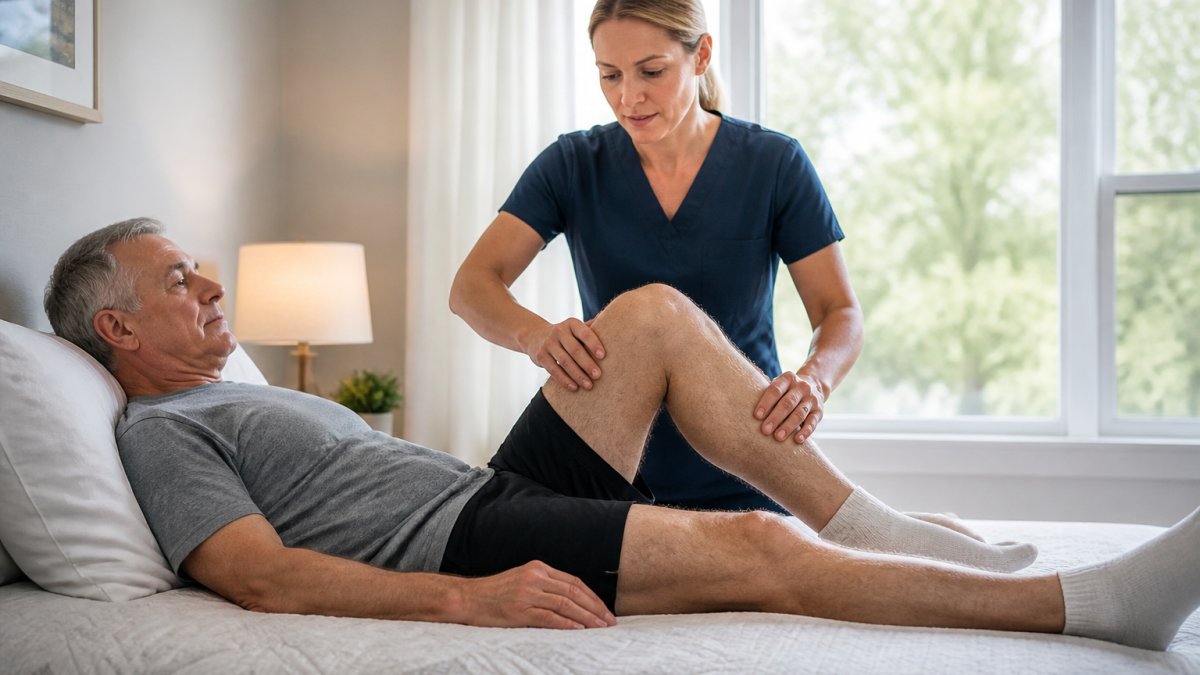
Ankle Pumps
Ankle pumps are the first exercise you learn, often the same day as surgery. They keep blood moving in your legs.
- Lie on your back with your legs straight.
- Point your toes away from you.
- Pull your toes back toward your shins.
- Repeat 10 to 20 times, several times an hour.
Heel Slides
Heel slides build knee flexion, the ability to bend your knee. This is one of the most important early moves.
- Lie on your back with your legs flat.
- Slide your heel toward your buttocks, bending the knee.
- Stop when you feel a firm stretch, not sharp pain.
- Hold for a few seconds, then slide back down.
Quadriceps Sets and Thigh Squeezes
Quadriceps sets wake up the thigh muscles that support your knee. A quadriceps set is a gentle contraction where you tighten the muscle without moving the joint.
- Lie flat with your leg straight.
- Press the back of your knee down into the bed.
- Tighten your thigh muscle and hold for 5 seconds.
- Relax, then repeat 10 times.
Straight Leg Raises
Straight leg raises strengthen the quadriceps and hip. Only add these once you can tighten your thigh without pain.
- Lie on your back with one leg bent and the other straight.
- Tighten the thigh of the straight leg.
- Lift the leg about 30 centimeters off the bed.
- Hold briefly, then lower slowly.
Seated Knee Flexion
Seated knee flexion helps you bend the knee while sitting. It is easier on the joint than standing work.
- Sit in a firm chair with your feet flat.
- Slide your foot back, bending the knee as far as you can.
- Hold for a few seconds, then slide forward.
- Repeat 10 times.
Standing Knee Bends and Raises
Standing knee bends and raises add body weight to the work. Hold your walker or a counter for support.
- Stand with both feet flat, holding support.
- Slowly bend the knee, keeping your foot down.
- Straighten back up.
- For raises, lift the knee toward your chest, then lower.
Knee Replacement Exercises at Home: Sets, Reps, and Frequency
Knee replacement exercises at home work best on a simple schedule: several short sessions a day, not one long one. Aim for quality reps over big numbers. The table below is a starting point, not a prescription, your physical therapist adjusts the dose based on your swelling, range of motion, and strength.
| Exercise | Reps | Hold | Frequency |
|---|---|---|---|
| Ankle pumps | 10-20 | 1-2 sec | Every hour while awake |
| Heel slides | 10 | 5 sec | 3-4 times daily |
| Quad sets | 10 | 5 sec | 3-4 times daily |
| Straight leg raises | 10 | 3 sec | 2-3 times daily |
| Seated knee flexion | 10 | 5 sec | 3 times daily |
| Standing knee bends | 10 | 2 sec | 2 times daily |
How to Track Range of Motion at Home
You do not need a goniometer, the tool your therapist uses to measure joint angles. A simple home method works:
- Extension (straightening): lie on your back and try to press the back of your knee flat to the bed. Note how far the heel lifts off the surface. A heel that touches down means you are close to full extension.
- Flexion (bending): sit in a chair with your feet flat and slide your foot back as far as it goes. Note where your heel lands relative to the front of the chair. Compare that spot week to week.
- Walking: count the number of houses or driveways you can walk before you need to stop, and note whether you limp.
Write these numbers down once a week. Trends matter more than any single day.
When to Reduce or Stop an Exercise
Discomfort during exercise is expected. Sharp pain, a hard block, or a joint that stays swollen for hours afterward is not. Use these rules:
- Reduce the dose if the knee is more swollen the next morning than it was before the session, or if you cannot bend it as far as you could the day before.
- Stop the exercise if you feel a sharp, catching, or pinching pain, or if the knee gives way.
- Do not push through a firm stretch to reach a number on the table. A firm stretch is fine; a sharp pain is a signal to back off. (Source: the benefits of early mobilization after surgery)
When to Call Your Care Team
Contact your surgeon or physical therapist if you notice:
- Fever, chills, or the knee becoming red, hot, and increasingly painful, possible signs of infection.
- Calf pain, tenderness, or swelling in one leg, especially with shortness of breath or chest pain, possible signs of a blood clot.
- A wound that is draining, opening, or not healing.
Fall Prevention While You Exercise
Most early exercises are done seated or lying down, but as you add standing work, falls become the main risk.
- Keep your walker or a sturdy counter within arm's reach for every standing exercise.
- Wear non-slip shoes, not socks, on hard floors.
- Clear rugs, cords, and pets from your exercise path.
Your physical therapist may adjust these numbers and rules based on your swelling and range of motion. Ask before you increase them.
Range of Motion Exercises After Knee Replacement
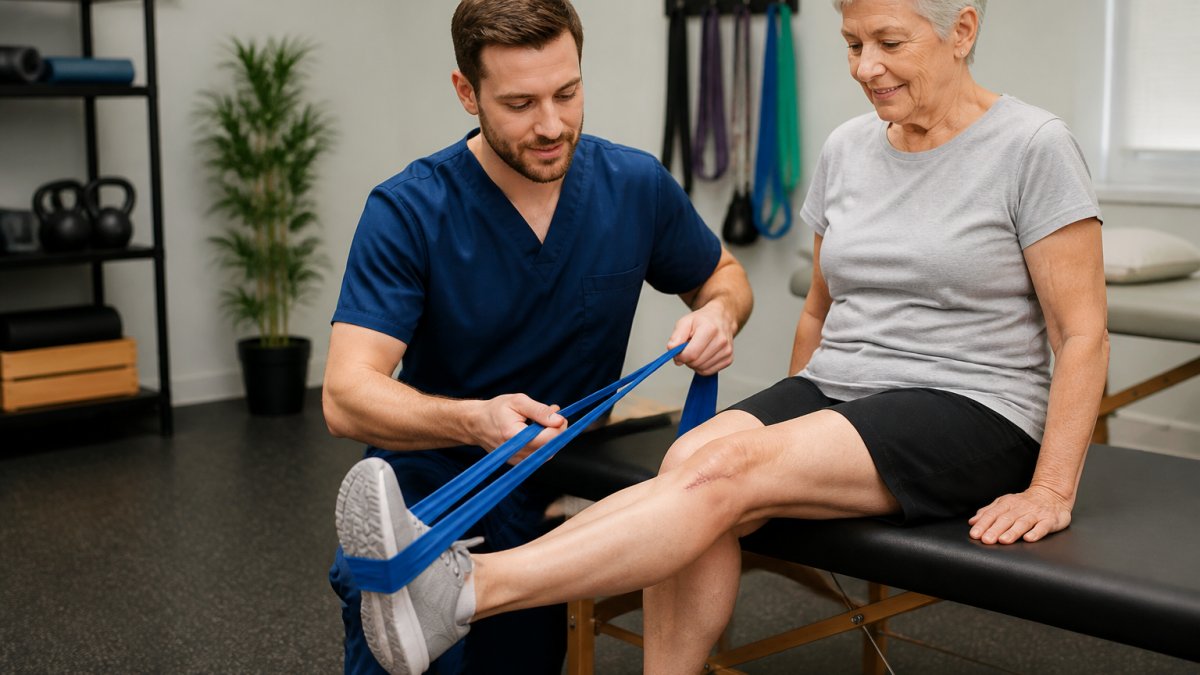
Range of motion exercises after knee replacement focus on two goals: getting the knee fully straight and bending it far enough to walk and climb stairs.
Gentle stretching, not forcing, is the rule. A physical therapist can measure your progress and adjust the plan. If your knee stays stiff despite steady work, tell your care team early.
Knee Replacement Recovery Timeline
The knee replacement recovery timeline is not a calendar, it is a set of milestones. Most surgeons and physical therapists advance you when you meet criteria, not when a certain week arrives. Two people who had surgery the same day can be three weeks apart in function, and that is normal.
Use the phases below as a map. Your care team sets your actual targets.
Phase 1: Early Recovery (roughly weeks 1-2)
Goal: protect the joint, control swelling, and wake up the quadriceps.
- Range of motion target: get the knee fully straight (0 degrees of extension) and bend to about 70-90 degrees.
- Walking: short distances with a walker or crutches, household only.
- Exercises: ankle pumps, heel slides, quad sets, seated knee flexion.
Move to Phase 2 when: you can straighten the knee fully, bend to about 90 degrees, do a quad set without pain, and get in and out of a chair with minimal help.
Phase 2: Intermediate Rehabilitation (roughly weeks 3-6)
Goal: restore motion and rebuild basic strength.
- Range of motion target: bend to 110-120 degrees, which is what you need for stairs, curbs, and getting out of a car.
- Walking: longer distances, graduating from a walker to a cane or no support as your therapist directs.
- Exercises: add straight leg raises, seated knee flexion with more range, standing knee bends, and light heel raises.
Move to Phase 3 when: you can walk a block or more without a limp, climb a step with a rail, and bend the knee past 110 degrees without a hard block.
Phase 3: Return to Activity (roughly weeks 6-12)
Goal: build strength and endurance for daily life.
- Exercises: add resistance, light ankle weights, a stationary bike with low resistance, step-ups, and mini squats holding a counter.
- Walking: aim for 20-30 minutes at a time, building distance gradually.
- Balance: single-leg stance work near a counter to reduce fall risk.
Move to Phase 4 when: you can walk 30 minutes without increased swelling, go up and down stairs with a normal pattern, and rise from a low chair without using your arms.
Phase 4: Longer-Term Recovery (roughly months 3-6 and beyond)
Goal: full strength and confidence for work, recreation, and uneven ground.
- Strength: most people reach near-normal quadriceps strength somewhere between 6 and 12 months, and some keep improving past a year.
- Activity: low-impact options such as walking, swimming, cycling, and golf are usually fine. High-impact running and jumping are decisions your surgeon makes with you.
- Range of motion: the bend you have at about 3 months is often close to the bend you keep long term, which is why the early weeks matter so much.
A common pattern is that progress feels fast in weeks 1-6 and then slows. That plateau is normal and is usually a sign to add resistance, not to stop.
Guidance from the National Institute of Arthritis and Musculoskeletal and Skin Diseases notes that recovery speed varies widely from person to person.
Common Mistakes to Avoid
The biggest mistake is skipping sessions on good days. Recovery rewards steady, small efforts, not occasional big ones. A few pitfalls to watch:
- Doing too much at once, which raises swelling
- Forcing a bend past a firm stretch
- Skipping ankle pumps, which help prevent clots
If you have knee osteoarthritis and want to avoid surgery, Natural Healing Arts Medical offers surgery-free treatment using viscosupplementation with Hyalgan. Dr. David Zamikoff and our team also provide physical therapy during your treatment program. We accept most health insurance and Medicare, with flexible payment plans available.
Frequently Asked Questions
Do you have to go to rehab after knee replacement?
Most people need some form of rehabilitation after knee replacement surgery. This can be outpatient physical therapy, in-home therapy, or a stay in a rehab facility, depending on your health, support system, and surgeon's recommendation. The physical therapy exercises after knee replacement are essential for regaining strength and range of motion. Even if you do exercises at home, guidance from a physical therapist helps ensure proper technique and progression.
How often should you do physical therapy exercises after knee replacement?
In the early weeks, aim for 3 to 5 sessions per day of short, gentle exercises like ankle pumps and heel slides. As you progress, your physical therapist may recommend 2 to 3 sessions per day. Each session might include 10 to 15 repetitions of each exercise. Consistency matters more than duration. Always follow your surgeon's or therapist's specific instructions, as your program may differ based on your recovery.
When can you start exercising after knee replacement?
You can usually start gentle exercises like ankle pumps and quad sets within hours after surgery, often while still in the hospital. Early exercises after knee replacement focus on circulation and muscle activation. Your surgeon will provide guidelines on when to begin more advanced movements. Most people begin formal physical therapy within a day or two after surgery, either in the hospital or at home.
What are the top mistakes to avoid after knee replacement surgery?
Common mistakes include pushing through sharp pain, skipping exercises on days you feel tired, and not using ice or elevation to manage swelling. Avoid twisting on your new knee or kneeling before your surgeon approves. Also, don't compare your recovery timeline to others; everyone heals at a different pace. Follow your physical therapist's plan and communicate any concerns promptly.
Knee recovery tests your patience as much as your strength. If surgery is not your only path, Natural Healing Arts Medical can help you explore options first. Our team offers surgery-free knee osteoarthritis treatment, physical therapy during your program, and flexible payment plans to fit your budget. Schedule an appointment with Natural Healing Arts Medical and take the next step toward lasting relief and freedom of movement.