 how-to
Strengthening Exercises for Knee Stability and Support
Table of Contents
- Why Strengthening the Muscles Around the Knee Matters
- What You'll Need Before You Start
- Knee Stabilization Exercises for Balance and Control
- Quadriceps Strengthening Exercises for Knee Support
- Low-Impact Knee Strengthening Exercises for Sensitive Joints
- Hip and Glute Strengthening for Better Knee Alignment
- Your Knee Strengthening Exercise Routine: A Week-by-Week Plan
- Common Technique Errors and Exercise Substitutions
- Frequently Asked Questions
Last Updated: October 18, 2026
Why Strengthening the Muscles Around the Knee Matters
Knee stability is the joint's ability to stay controlled and supported during movement, and it depends on the muscles around the knee doing their job.
That load shows up as aching, buckling, or unease on stairs.
The muscles around the knee do three jobs:
- Quadriceps straighten the leg and absorb landing force
- Hamstrings slow the leg down and protect the joint from behind
- Gluteal muscles keep the knee tracking over the toes
When any of these get weak, the knee joint takes more stress. Strengthening exercises for knee stability and support help rebuild that team.
The payoff is practical. The American Academy of Orthopaedic Surgeons notes that muscle strengthening is a core part of managing knee arthritis and protecting the joint.
What You'll Need Before You Start
You need very little to begin: a sturdy chair, a wall, a towel, and a resistance band. A step or low stool helps later.
Before your first rep, run through this checklist:
- Clear a small space with room to lie down
- Use a chair that will not slide
- Wear supportive shoes or go barefoot on a non-slip floor
One common mistake is starting with too much resistance. Start with bodyweight and add a band only when the movement feels easy and controlled.
Knee Stabilization Exercises for Balance and Control
Knee stabilization exercises train control, not just strength, teaching the muscles around the knee to react quickly when balance is challenged. Do these barefoot, near a wall or counter you can grab, and keep the effort slow enough to stop mid-movement.
Strength gives the knee a bigger engine; balance control gives it better steering. You need both, and balance work is what most home programs skip.
A Graded Balance Progression
Start at Level 1 and stay there until you can complete the full dose with no hand support and no wobble that makes you grab the counter.
Level 1, Supported single-leg stance. Stand on one leg with a soft knee and a fingertip on the counter. Hold 20-30 seconds.
Level 2, Freestanding single-leg stance. Same hold and dose, no hands.
Level 3, Single-leg reach. Balance on one leg and tap the other foot forward, then to the side, then slightly behind.
Single-Leg Balance and Proprioception Drills
Proprioception is your body's sense of where the joint is in space, and it keeps the knee from giving way on stairs or uneven ground.
The progression that matters is removing support, not adding time: a 20-second hands-free hold is harder than a 60-second hold with a fingertip on the counter.
A simple weekly dose: 3-5 days per week, 3 holds per leg, 20-30 seconds each, plus 2 sets of reaches once you reach Level 3.
If single-leg work consistently feels unstable or the knee gives way, stop progressing and get the knee evaluated before adding difficulty.
Quadriceps Strengthening Exercises for Knee Support
Quadriceps strengthening exercises are the foundation of knee support. The quadriceps, the large muscle group on the front of the thigh, does most of the work of protecting the knee joint.
Two moves cover a lot of ground: the quad set and the straight-leg raise. Both are low-impact, and both can be done on the floor at home.
Quad Sets and Straight-Leg Raises
- Quad set. Sit or lie with the leg straight. Press the knee down into a towel, tighten the thigh, hold 5 seconds, relax. 10-15 reps.
- Straight-leg raise. Lie on your back, one knee bent. Tighten the straight leg's thigh, lift the leg about 30 cm, hold 3 seconds, lower slowly. 10-12 reps.
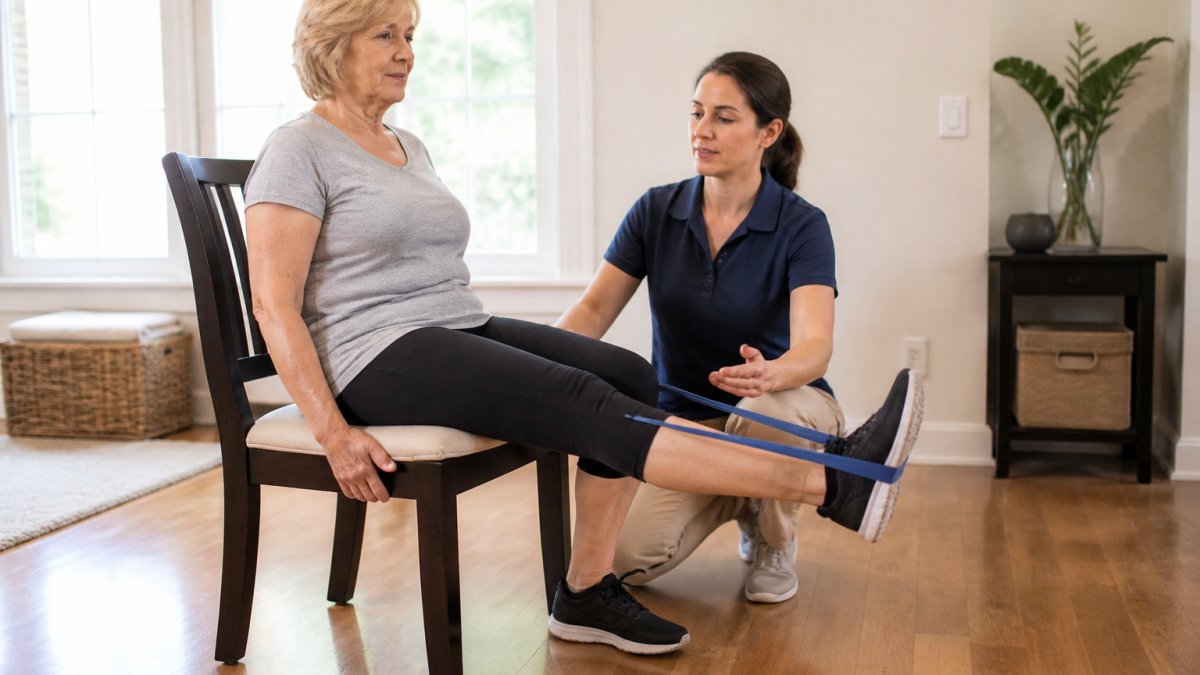
- Seated knee extension. Sit tall in a chair and straighten one leg fully, hold 2 seconds, lower. Add a resistance band around the ankle when it gets easy.
The straight-leg raise is your gauge. If your knee bends on the way up, the quadriceps is not holding the leg straight yet. Reduce the height and tighten the thigh first.
Low-Impact Knee Strengthening Exercises for Sensitive Joints
Low-impact knee strengthening exercises build strength without hammering the joint, suiting people with knee pain, stiffness, or a flare-up that is settling down.
The rule with sensitive joints is simple: work in a pain-free range and build slowly. If a movement causes more than mild discomfort, shrink the range or skip it that day.
Chair-Based and Seated Options
- Seated knee extension. Straighten the leg from a chair, hold, lower. Excellent for quadriceps activation with zero balance demand.
- Chair-supported mini squat. Hold the chair back, bend the knees slightly, press back up. Keep the movement small.
- Seated marching. Lift one knee at a time while seated, keeping the back tall.
- Heel slides. Slide the heel toward the chair to bend the knee, then slide out. Good for knee mobility.
Chair-supported exercise is not a lesser option; it is often the smartest starting point and lets you train daily without irritating the joint.
Hip and Glute Strengthening for Better Knee Alignment
Hip and glute strengthening fixes the root of many knee problems. The hip muscles control how the thigh rotates, which decides whether the knee tracks straight or caves inward during squats, stairs, and single-leg landings.
Weak hip muscles let the knee drift inward, loading the joint unevenly, one of the most common patterns in people with knee pain. The fix is not just stronger quads; it is quads plus hips working together.
Four Hip and Glute Moves With Dosage
Do these 2-3 days per week, 2-3 sets of 10-15 slow reps. A rep should take about 4 seconds: 2 seconds to lift, 2 seconds to lower.
- Bridging. Lie on your back, knees bent, feet flat and hip-width apart. Squeeze the glutes and lift the hips until the body forms a straight line from knees to shoulders. Hold 2 seconds at the top, lower slowly. 12-15 reps. Keep the ribs down; if your lower back arches, you have lifted too high.
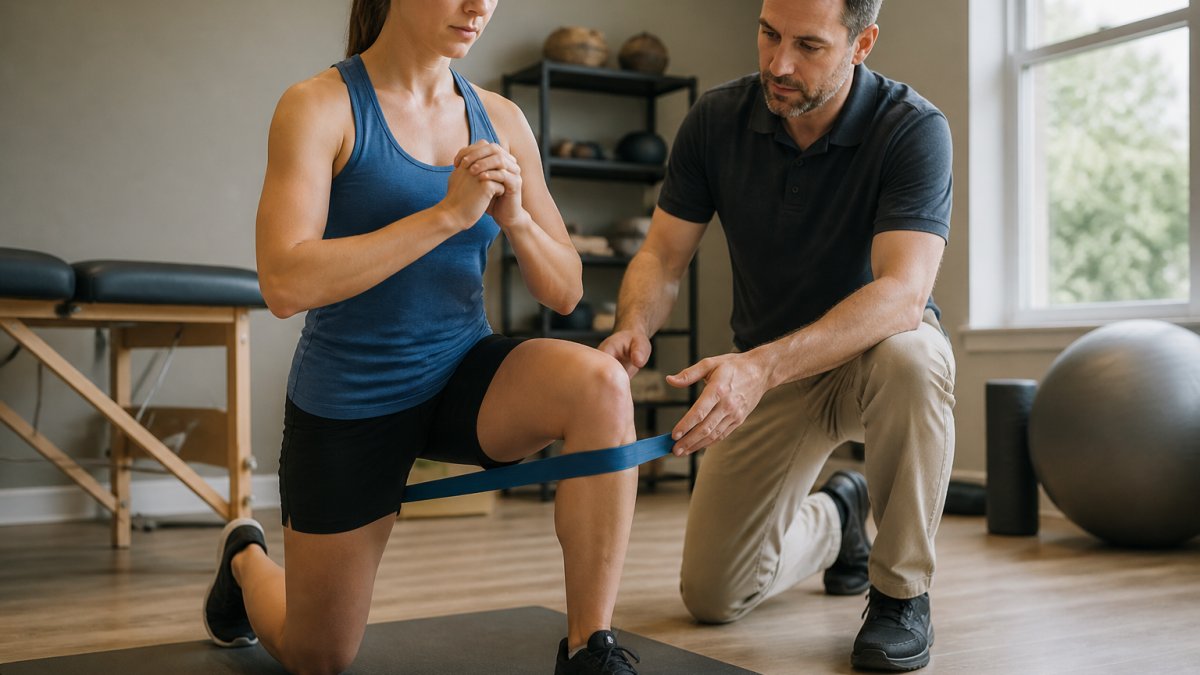
- Clamshell. Lie on your side with a resistance band above the knees, hips and knees bent about 45 degrees. Keeping the feet together, open the top knee against the band, then lower slowly. 10-15 reps per side. Do not roll the pelvis backward to get more range.
- Side-lying leg lift. Lie on your side with the bottom knee bent for support. Keep the top leg straight and lift it to about 45 degrees, toes pointing forward, then lower slowly. 10-15 reps per side. If the front of the hip burns, the leg has gone too high or the hip has rolled forward.
- Standing hip abduction. Hold a chair and lift one leg out to the side, keeping the torso upright and the toes forward. 10-15 reps per side. Add a band around the ankles once bodyweight feels easy.
Form Cues and Common Errors
You should feel these in the glutes, not the front of the hip or lower back. If the front of the hip burns during side-lying work, reduce the height and check that the pelvis is not rolling backward.
Hip muscles often fatigue before the quads. That is normal at first; keep reps slow and stop the set when form changes rather than pushing for extra reps.
When to Substitute
- Clamshell bothers the outside of the hip? Use a standing banded hip abduction instead.
- Bridging irritates the lower back? Reduce the height and hold the top for 2 seconds before lowering.
- Side-lying leg lift is uncomfortable? Do standing hip abduction with a chair for support.
If hip strengthening does not change the inward knee drift after four to six weeks, a professional evaluation can help identify whether the issue is strength, balance, or joint mechanics.
Your Knee Strengthening Exercise Routine: A Week-by-Week Plan
A knee strengthening exercise routine works best when it progresses. Random exercises done occasionally do not build much. A planned ramp does.
| Week | Focus | Frequency | What to Add |
|---|---|---|---|
| 1 | Quad sets, straight-leg raises, seated extensions | 5 days | Bodyweight only, 2 sets |
| 2 | Add bridging and clamshells | 5 days | 3 sets, slower tempo |
| 3 | Add mini squats and single-leg stance | 4-5 days | Light resistance band |
| 4 | Add step-downs and lateral band walks | 3-4 days | Balance challenges, eyes closed |
| 5-6 | Combine strength and balance in one session | 3 days | Longer holds, more reps |
Keep walking on the off days. Walking is low-impact exercise that keeps the knee joint moving without adding much load.
Dosage, Progression, and Pain Response
Dosage is where most home programs fall apart. Aim for 2-3 sets of 10-15 slow reps, about 4 seconds each: 2 up, 2 down.
Progress in this order:
- More reps
- More sets
- Slower tempo
- Added resistance
- Harder variation
Pain response is your guide. Mild soreness settling within a day is normal.
If knee pain keeps limiting your progress, a professional evaluation can help. At Natural Healing Arts Medical, we offer surgery-free treatment for knee osteoarthritis using viscosupplementation with Hyalgan, along with physical therapy during the treatment program.
Common Technique Errors and Exercise Substitutions
Technique errors are the quiet reason a program stalls. The muscles never get the signal, and the joint absorbs the work instead.
The errors we see most often:
- Rushing the reps. Fast reps let momentum do the work.
- Letting the knee cave inward. Watch the knee over the middle toes.
- Holding the breath. Breathe out on the effort.
When a move hurts, substitute rather than quit:
- Straight-leg raise bothers the hip? Use a seated knee extension.
- Mini squats hurt the kneecap? Reduce depth and hold a chair.
- Single-leg stance feels unstable? Use a fingertip on the counter.
The Arthritis Foundation and CDC physical activity guidance both point to the same idea: regular, moderate movement supports joint health better than occasional hard sessions. Consistency beats intensity.
Frequently Asked Questions
How often should I do knee strengthening exercises?
Aim for two to three sessions per week on non-consecutive days, which gives the muscles around the knee time to recover. Each session can include two to three sets of eight to twelve repetitions per exercise. Start with bodyweight movements and add a resistance band only when you can complete all reps with proper form and no increase in pain. If your knee feels sore for more than 24 hours afterward, reduce the volume or resistance next time.
Which quadriceps strengthening exercises are best for knee support?
Quad sets and straight-leg raises are the safest starting points because they load the quadriceps with minimal joint movement. Lie on your back with the knee straight, tighten the thigh muscle, and hold for five seconds for a quad set. For a straight-leg raise, lift the straightened leg about twelve inches, hold briefly, and lower slowly. Once those feel easy, progress to mini squats and seated knee extensions. A physical therapist can tailor the sequence to your specific knee issue.
Can I do knee stabilization exercises if I have pain or swelling?
Mild discomfort during exercise is common, but sharp pain, new swelling, or pain that lingers past a day is a signal to stop and check in with a healthcare professional. When swelling is present, start with isometric holds like quad sets and avoid deep bending until it settles. Low-impact options such as chair-supported exercises and glute bridges keep you moving without overloading the joint. Never push through pain that changes your walking pattern.
How long does it take to see results from a knee strengthening exercise routine?
Most people notice better balance and easier daily movements within four to six weeks of consistent practice, while meaningful strength gains typically take eight to twelve weeks. Progress depends on your starting point, how often you train, and whether you add resistance gradually. Track small markers like standing from a chair without using your arms or walking down stairs with less hesitation. If you see no change after six weeks, ask a healthcare professional to review your form and dosage.
Knee pain that keeps returning is a sign the support system needs more than a few exercises. At Natural Healing Arts Medical, we build a plan around your knee, your goals, and your daily life. Our surgery-free viscosupplementation treatment, physical therapy during your program, and insurance-friendly billing help you get moving again without surgery. Schedule an appointment and take the first step toward lasting knee support.