 how-to
Yoga Poses for Stress-Related Back Pain: A Gentle Guide
Last Updated: November 4, 2026
Quick Summary
Gentle yoga poses for stress-related back pain include Cat-Cow, Child's Pose, Sphinx Pose, and Bridge Pose, each paired with slow breathing cues that calm the nervous system while easing tight muscles. A 5-minute daily routine works better than one long weekly session, and you should move at half the speed you think you should.
- Stress-related back pain is muscle tension and stiffness that builds when your body stays in a low-grade on guard state.
- Breathe through your nose the whole time, and if a pose pinches or burns, back off.
- Do 8-10 rounds of Cat-Cow, making each exhale a little longer than the inhale.
- A short daily routine beats one long weekly session for stress-related back pain.
- Skip deep twists and fast flows, and never push into pain to get a better stretch.
Table of Contents
- Why Stress Settles in Your Back
- Yoga Poses for Stress-Related Back Pain Beginners Can Start Today
- Yoga Poses for Stress-Related Back Pain at Home: Setting Up Safely
- A 5-Minute Yoga Routine for Lower Back Pain
- Yoga Poses for Stress-Related Back Pain With Pictures: How to Check Your Form
- Matching Poses to Where It Hurts
- Red Flags: When to See a Doctor Instead of Your Mat
- Pairing Gentle Yoga With Professional Care
- Frequently Asked Questions
Why Stress Settles in Your Back
Yoga poses for stress related back pain work because they treat both problems at once: the tension in your muscles and the stress that keeps feeding it.
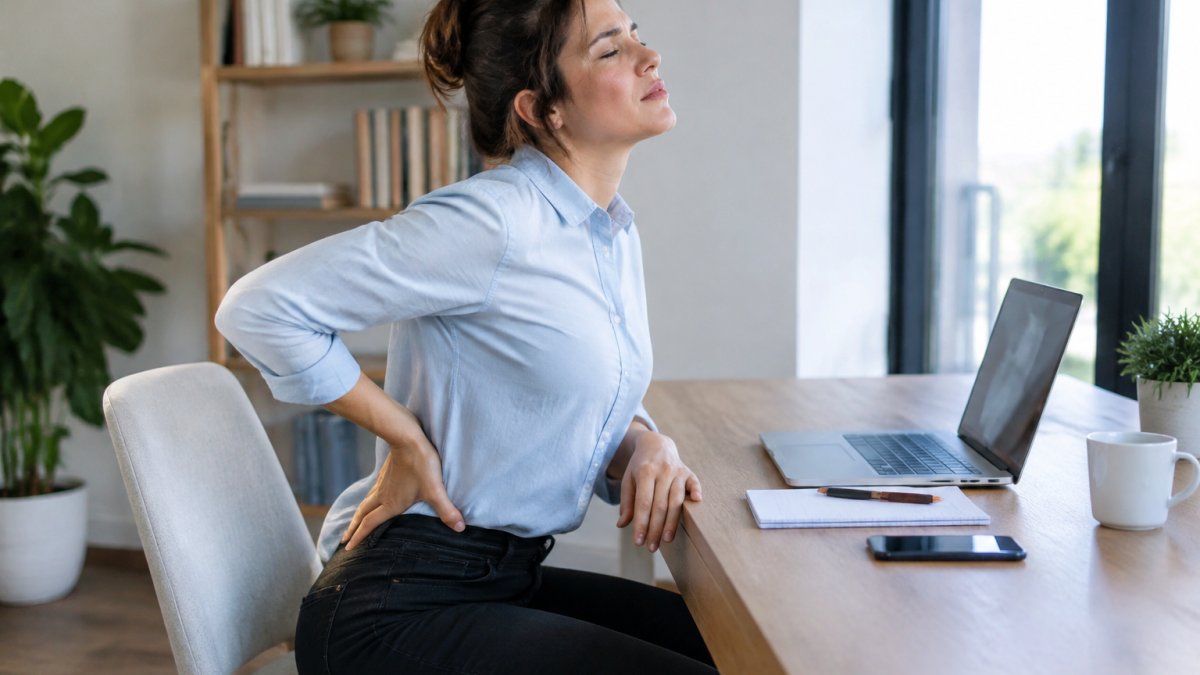
Stress-related back pain is muscle tension and stiffness that builds when your body stays in a low-grade "on guard" state. Your nervous system never fully powers down, so your back muscles stay partly contracted for hours.
How Stress Tightens Back Muscles
When you're stressed, your body releases hormones that prepare you to react. Your muscles tense up, especially in the neck, shoulders, and lower back. That response is useful for a few minutes. It becomes a problem when it lasts all day.
The muscles around your spine stay tight, blood flow drops, and you feel stiff and achy. The American Psychological Association's stress effects resource notes that chronic stress keeps the body in a sustained state of physical arousal, which shows up as muscle tension.
What Stress-Related Back Pain Feels Like
It rarely feels like a sharp, sudden injury. Most people describe it as:
- A dull ache that settles in by late afternoon
- Tightness across the lower back or between the shoulder blades
- Stiffness that's worse in the morning or after sitting
The discomfort often moves around. One day it's your neck, the next it's your lower back. That wandering pattern is a clue that stress, not a single injury, is driving it.
Want the full picture on how tension and pain feed each other? Read our guide on how stress impacts chronic back pain levels.
Yoga Poses for Stress-Related Back Pain Beginners Can Start Today
Yoga poses for stress related back pain beginners can try safely are gentle, slow, and breath-focused. You don't need flexibility or experience. You need a mat, a few minutes, and permission to move slowly.
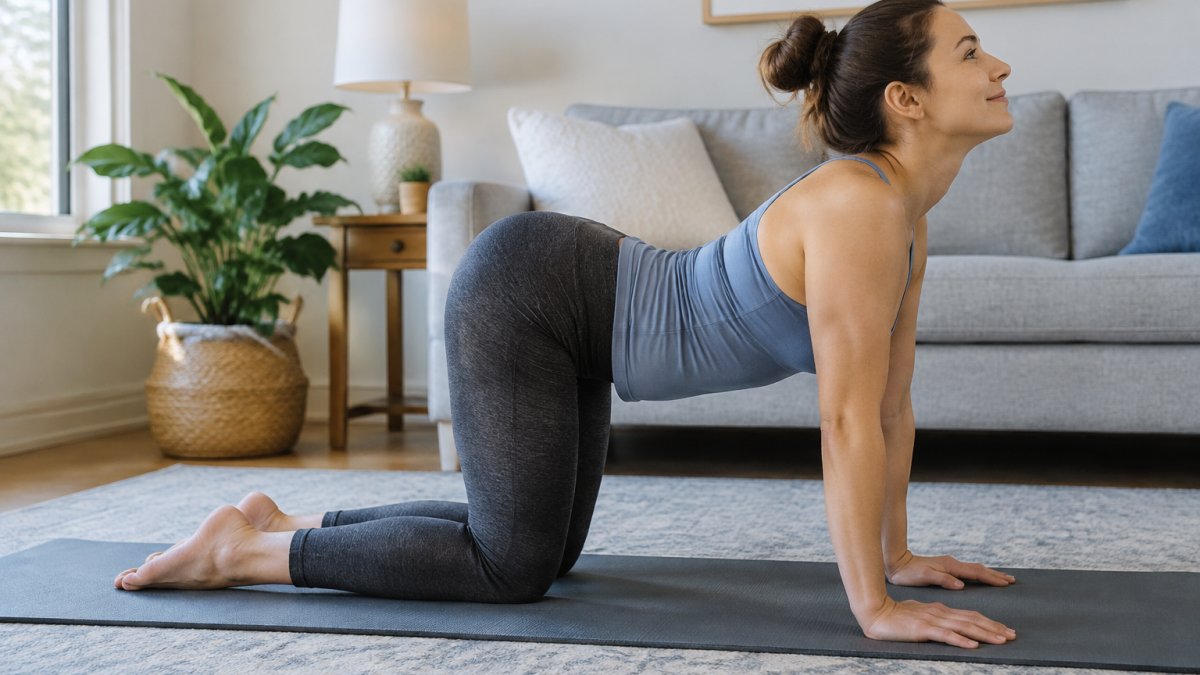
Breathe through your nose the whole time. If a pose pinches or burns, back off. Gentle movement should feel like relief, not effort.
Cat-Cow Pose for Spinal Mobility
Cat-Cow is the best warm-up for a stiff spine. It moves every segment of your back gently and gives you an easy way to coordinate breath with movement.
- Start on hands and knees, wrists under shoulders, knees under hips.
- Inhale, drop your belly, lift your chest and tailbone (Cow).
- Exhale, round your spine, tuck your chin and tailbone (Cat).
- Move slowly with your breath for 8-10 rounds, making each exhale a little longer than the inhale.
This pose gently moves the spine and can help warm up the back muscles before deeper stretches. If your wrists feel uncomfortable, try making fists and resting on your knuckles, or place a folded towel under each palm.
Child's Pose and Bridge Pose
Child's Pose gently stretches the lower back and many people find it relaxing. Kneel, sit back on your heels, and fold forward with arms extended.
Bridge Pose builds core and hip strength, which supports the spine. Lie on your back, knees bent, feet flat. Press through your feet and lift your hips a few inches. Hold for 3 breaths, lower slowly, and repeat.
Sphinx Pose and Downward-Facing Dog
Sphinx Pose is a gentle back extension. Lie on your belly, prop up on your forearms, and let your lower back relax. Hold for 5 breaths.
Downward-Facing Dog stretches the back and legs together. From hands and knees, lift your hips up and back into an upside-down V. Bend your knees as much as you need. Hold for 5 breaths.
Choosing Poses by Where It Hurts
Rather than doing every pose every day, match the movement to your symptoms. This is the step most pose lists skip.
- Lower back ache: Child's Pose, knees-to-chest, Cat-Cow.
- Upper back and between-the-shoulder-blades tension: Sphinx Pose, thread-the-needle, gentle chest openers.
- Neck and shoulder tightness: slow neck turns, Cat-Cow with a soft gaze, shoulder rolls.
If one area flares when you move, stop that pose and try a gentler version. Pain that travels down your leg or worsens with movement needs a professional look, not more stretching.
Yoga Poses for Stress-Related Back Pain at Home: Setting Up Safely
Yoga poses for stress related back pain at home work best when your setup removes distractions. A safe space lets you relax instead of guard your body.
Use these basics:
- A non-slip mat on a flat, clear floor
- A folded blanket or pillow for knee and hip support
- Warmth: cold muscles resist stretching (Source: the National Center for Complementary and Integrative Health's information on yoga for back pain)
Skip deep twists, fast flows, and anything that forces a stretch. Move at half the speed you think you should. And never push into pain to "get a better stretch." That's the most common mistake we see.
A 5-Minute Yoga Routine for Lower Back Pain
A short daily routine beats one long weekly session. The sequence below is built for stress-related back pain specifically, so every pose is paired with a breathing cue that downshifts the nervous system while it lengthens tight muscle.
| Minute | Pose | Breathing cue | Focus |
|---|---|---|---|
| 0:00-1:00 | Cat-Cow | Inhale to arch, exhale to round; make the exhale twice as long | Warm up the spine and sync breath to movement |
| 1:00-2:00 | Child's Pose | Five slow breaths, silently count to four in and six out | Release the lower back and settle the nervous system |
| 2:00-3:00 | Sphinx Pose | Steady nasal breathing, soften the jaw and shoulders | Gentle extension to counter desk rounding |
| 3:00-4:00 | Bridge Pose | Exhale as you lift, inhale as you lower; five slow reps | Strengthen hips and core to support the spine |
| 4:00-5:00 | Supine twist or knees-to-chest | Long exhales, let the belly soften | Unwind and cool down |
Do this in the morning to loosen up, or in the evening to unwind. Watch out: if you feel a pinch in the lower back during Sphinx or Bridge, reduce the range by half rather than pushing through it, stress-tightened muscles guard harder when forced.
A 10-Minute Version for Desk Breaks
When you have been sitting for more than an hour, add these two poses between Cat-Cow and Child's Pose, holding each for one minute with slow nasal breathing:
- Standing forward fold with bent knees, hang heavy, let the head relax, and breathe into the back ribs for 60 seconds.
- Thread-the-needle, from hands and knees, slide one arm under the chest and rest the shoulder and ear on the mat; hold 30 seconds per side. This targets the upper-back and between-the-shoulder-blades tension that builds during screen work.
Finish with the last three rows of the 5-minute table. Total time is about 10 minutes, and it fits between meetings without a change of clothes.
A 20-Minute Version for Winding Down
For evening practice, run the 5-minute sequence once, then repeat it with longer holds: two minutes in Child's Pose, two minutes in Sphinx, and three minutes in a supported supine twist with a pillow under the knees. Close with five minutes of legs-up-the-wall while breathing four counts in and six counts out. A longer exhale is one simple way many people use to help the body wind down.
Pair the routine with good sleep habits. Our guide to the best sleeping positions for lower back pain shows how to protect your back overnight.
Yoga Poses for Stress-Related Back Pain With Pictures: How to Check Your Form
Yoga poses for stress related back pain with pictures help you spot form errors a text description can't show. Use photos or video to check three things.
First, look at your spine. In Cat-Cow, the curve should travel smoothly from tailbone to neck, not hinge in one spot. Second, check your shoulders. Third, watch your breath.
Film yourself from the side for 30 seconds. Compare your shape to a trusted photo of the pose.
Matching Poses to Where It Hurts
Different pain locations call for different poses. Match the movement to your symptoms.
- Lower back ache: Child's Pose, knees-to-chest, Cat-Cow
- Upper back tension: Sphinx Pose, gentle chest openers, shoulder rolls
- Neck and shoulder tightness: slow neck turns, Cat-Cow with a soft gaze
If one area flares when you move, stop that pose and try a gentler version. Pain that travels down your leg or worsens with movement needs a professional look, not more stretching.
Red Flags: When to See a Doctor Instead of Your Mat
Some back pain needs medical care, not yoga. Stop and seek evaluation if you notice:
- Numbness or weakness in your legs
- Loss of bladder or bowel control
- Pain after a fall or accident
These signs can point to something more serious than muscle tension. Yoga won't fix them, and delaying care can make things worse. If you're unsure whether professional care is right for you, read about when to choose physical therapy for back pain.
Pairing Gentle Yoga With Professional Care
Yoga may help with stress and keep the spine moving. It can complement professional care, and a qualified clinician can help identify the cause of your pain and build a plan around it.
At Natural Healing Arts Medical, physical therapy is included in the treatment program. For readers combining yoga with clinical care, our guide on exercises to complement chiropractic back treatment shows what to add to your routine.
Start with the 5-minute routine, keep your movements gentle, and give it a few weeks. If stress keeps tightening your back, schedule an appointment with our team to build a plan that fits your body.
Frequently Asked Questions
How long should you do yoga for lower back pain?
A short session of 5 to 15 minutes most days beats a long session once a week. Start with the 5-minute routine in this guide, holding each pose for 3 to 5 breaths, and add time as your back tolerates it. Stop if pain sharpens or travels down your leg. If discomfort lasts more than a few weeks or keeps returning, have a qualified professional assess your back before pushing further.
Can beginners do yoga for back pain at home?
Yes, with a few precautions. Choose gentle poses such as Cat-Cow, Child's Pose, and Bridge, and skip deep twists or forward folds until you know how your back responds. Work on a non-slip mat on a flat floor, keep a folded blanket nearby for knee support, and move slowly enough to notice tension building. If you have a diagnosed disc injury, sciatica, or recent injury, check with your doctor or chiropractor before starting.
What does back pain from stress feel like?
Stress-related back pain often shows up as tightness or a dull ache across the upper back, shoulders, and lower back rather than a sharp, pinpoint pain. Muscles feel knotted and stiff, especially after long desk hours, and the discomfort tends to ease when you relax and return when tension climbs. Sharp pain, numbness, or weakness is a different picture and warrants a medical evaluation.
Is yoga safe for lower back pain?
Gentle yoga is generally well tolerated for common lower back pain, but safety depends on the poses and your starting point. Favor slow, supported movement over deep backbends and aggressive stretching. Skip poses that send pain down the leg, and never force a stretch into sharp discomfort. If you have sciatica, a disc injury, or pain that has lasted months, get clearance from a qualified professional and consider combining yoga with hands-on care.
Back pain that keeps returning is your body asking for a different approach. Natural Healing Arts Medical can help you find the cause and treat it with surgery-free options, physical therapy during your program, and care that accepts most insurance and Medicare. Get started with Natural Healing Arts Medical and take the first step toward lasting relief and freedom of movement.